


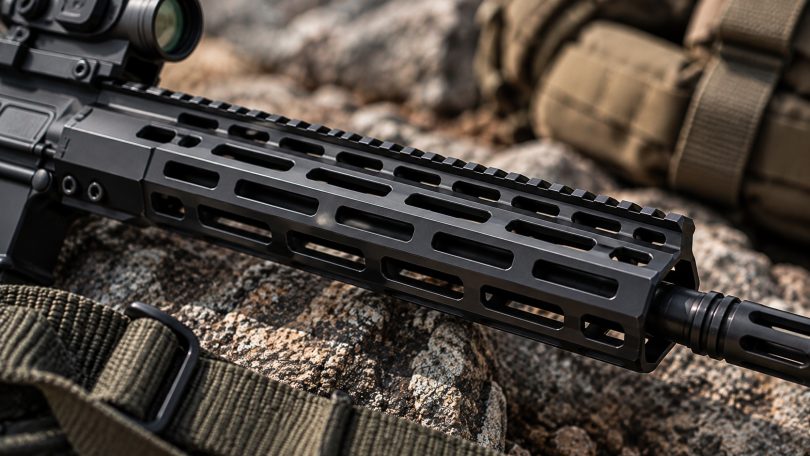

An AR-15 handguard is the part that surrounds the barrel and gives you a safe, practical place to support and control the rifle without grabbing a hot barrel. On modern AR-15s, the handguard also commonly provides mounting points for accessories.
It’s one of the largest components on the rifle, and it has a bigger effect on how an AR feels than you might expect.
Handguard length, weight, diameter, mounting system, and construction can all change how a rifle handles.
What Does an AR-15 Handguard Do?
At its most basic, the handguard separates your support hand from the barrel and other hot components.
Barrels heat up when a rifle is fired. The handguard gives you a place to hold and control the front of the rifle without directly contacting that hot barrel.
A modern AR-15 handguard may also provide mounting surfaces for accessories such as:
- Weapon lights
- Sling attachment points
- Backup sights
- Bipods
- Hand stops
- Other compatible accessories
That combination of protection, control, and accessory mounting is why the handguard has become such an important part of the modern AR platform.
Where Is the Handguard Located?
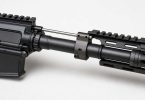
The handguard extends forward from the upper receiver and surrounds much of the barrel.
Depending on the rifle and handguard design, components of the gas system may also sit underneath it.
The barrel itself remains inside the handguard but should not be confused with the handguard. They’re separate components with very different jobs.
What Is a Rail System?
You’ll hear the terms handguard and rail used almost interchangeably.
They aren’t exactly the same thing.
The handguard is the structure surrounding the barrel. A rail or accessory-mounting system is a feature incorporated into that handguard.
Older designs often used large sections of Picatinny rail. Many modern handguards instead use slimmer mounting systems such as M-LOK, sometimes with a Picatinny rail running along the top.
So when someone calls an AR handguard a “rail,” you usually know what they mean. Technically, though, the rail is part of the handguard’s mounting system.
What Is a Free-Float Handguard?
A free-float handguard is designed so the handguard does not contact the barrel along its length.
Instead, the handguard is typically secured around the barrel nut area at the receiver.
Why does that matter?
Pressure placed on a handguard that contacts the barrel can potentially influence the barrel. A free-float design isolates the barrel from much of the external pressure placed on the handguard.
That’s one reason free-float handguards have become common on modern AR-15s, particularly when consistency and accessory mounting are priorities.
The trade-off is that a free-float system can cost more and may be more involved than a basic traditional handguard.
Not every rifle needs an expensive free-float rail to do its job.
What Is a Drop-In Handguard?
A drop-in handguard generally fits into an existing handguard mounting system rather than attaching as a free-floating structure around the barrel nut.
Traditional AR-15 and M4-style polymer handguards are familiar examples of this approach.
They’re simple, proven, and perfectly usable for many rifles.
The trade-off is that traditional drop-in systems generally offer less mounting flexibility and don’t isolate the barrel the way a free-float handguard does.
That doesn’t make them obsolete. It just means they solve a different problem.
What Is M-LOK?
M-LOK is an accessory-mounting interface commonly found on modern AR-15 handguards.
Instead of covering the entire handguard with raised rail sections, an M-LOK handguard uses slots where compatible accessories or rail sections can be attached.
This allows manufacturers to build relatively slim handguards while giving the shooter flexibility over where accessories are positioned.
It also means you don’t need unused Picatinny rail covering every surface of the handguard.
What Is a Picatinny Rail?
Picatinny rail uses a series of raised sections and cross slots that provide standardized mounting locations for compatible accessories.
You’ll commonly find a Picatinny rail running along the top of an AR-15 upper receiver and many handguards.
Some handguards also use Picatinny rail around additional sides of the handguard.
Picatinny is extremely versatile, but covering an entire handguard with rail can add weight and create a bulkier gripping surface.
The trade-off is straightforward: more continuous rail gives you plenty of mounting space, but it can also mean more material, more weight, and a less streamlined handguard.
Does Handguard Length Matter?
Yes.
A longer handguard provides more room for your support hand and accessories. It can also cover more of the barrel and provide additional mounting positions.
But longer also means more material.
That can mean additional weight toward the front of the rifle.
A shorter handguard can make an AR feel more compact and keep weight down, but it gives you less usable space.
The longest handguard isn’t automatically the best handguard.
The useful question is whether the additional length provides something you actually need.
Does Handguard Weight Matter?
Absolutely.
Where weight sits on an AR matters almost as much as the number on the scale.
Weight added around the handguard sits toward the front of the rifle. Add a heavy handguard, light, sling hardware, bipod, and other accessories, and a rifle that looked lightweight on paper can become noticeably front-heavy.
That matters when you’re carrying the rifle for hours rather than shooting a few rounds from a bench.
The trade-off with extremely lightweight handguards is that cutting material and weight can come with compromises in rigidity, durability, heat management, or mounting space depending on the design.
Again, there is no free lunch.
Can You Mount an Optic on the Handguard?
For a typical AR-15 setup, the primary optic is generally mounted to the upper receiver rather than out on the handguard.
The upper receiver provides the conventional mounting location for maintaining a stable relationship between the optic and the rifle.
The handguard’s top rail is still useful for appropriate accessories and certain sighting components, but don’t assume every available rail slot is an equally appropriate location for a primary optic.
Does the Handguard Get Hot?
It can.
The handguard keeps your hand from directly contacting the barrel, but heat generated by the barrel and gas system doesn’t simply disappear.
How quickly you notice that heat depends on the rifle, handguard construction, firing schedule, and other factors.
This is another area where design involves trade-offs.
A slim, lightweight handguard may feel great in your hands. A heavier design may provide different heat characteristics or rigidity. Neither characteristic tells the whole story by itself.
Do You Need an Aftermarket AR-15 Handguard?
Not automatically.
If the existing handguard gives you the grip, mounting space, weight, and functionality you need, replacing it simply because another design looks newer isn’t much of an upgrade.
An aftermarket handguard makes more sense when you’re trying to solve a specific problem.
Maybe you need:
- More usable mounting space
- Less weight
- A slimmer gripping surface
- A longer support-hand position
- M-LOK compatibility
- A free-float design
- Different sling mounting options
Start with the problem. Then choose the hardware.
What Should You Look for in an AR-15 Handguard?
Don’t judge a handguard entirely by how it looks.
Consider how the rifle will actually be used.
Important factors include:
- Length
- Weight
- Outside diameter and grip feel
- Free-float or drop-in construction
- Accessory mounting system
- Rigidity
- Heat management
- Sling mounting options
- Compatibility with the rest of the rifle
A bench rifle, hunting rifle, and lightweight general-purpose AR can all benefit from different priorities.
That’s why there isn’t one perfect handguard for every AR-15.
The Bottom Line
An AR-15 handguard surrounds the barrel and provides a practical place to support and control the rifle while helping keep your hands away from the hot barrel.
Modern handguards can also provide mounting space for lights, sling hardware, bipods, and other accessories.
Free-float designs, drop-in handguards, M-LOK slots, and Picatinny rails are different approaches to accomplishing those jobs.
The best choice isn’t necessarily the longest, lightest, or most expensive option.
It’s the handguard that gives your rifle the grip, mounting space, weight, and functionality its intended use actually requires.