


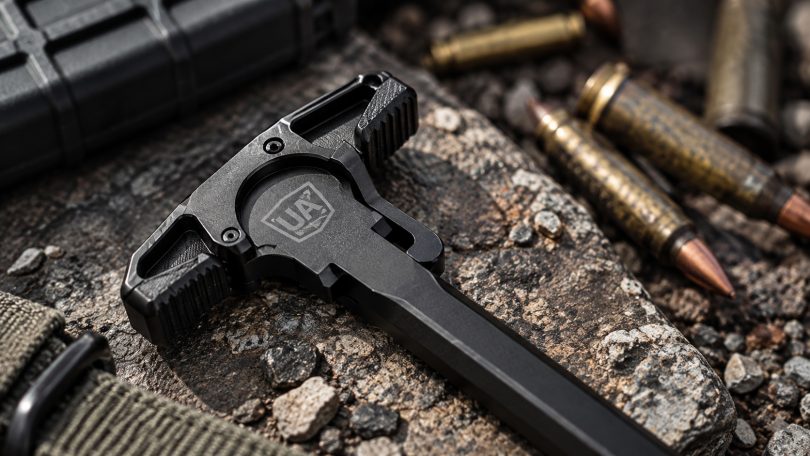

The charging handle is the manually operated control used to pull an AR-15’s bolt carrier group to the rear. It allows the shooter to manually cycle the action when loading the rifle, clearing the chamber, or checking its condition.
It looks simple because it is simple.
But the charging handle is one of the first controls you’ll interact with on an AR-15, and its location and design are a little different from what you’ll find on many other rifles.
What Does an AR-15 Charging Handle Do?
The charging handle gives the shooter a way to manually move the bolt carrier group rearward.
Pulling the charging handle to the rear draws the bolt carrier group back with it. When the charging handle is released, the rifle’s action spring drives the bolt carrier group forward while the charging handle returns to its normal position.
Depending on what you’re doing with the rifle, the charging handle can be used when:
- Initially loading the rifle
- Manually opening the action
- Clearing the chamber
- Locking the bolt to the rear in conjunction with the bolt catch
- Checking the rifle’s condition
- Addressing certain stoppages
One thing it does not normally do is move back and forth every time the rifle fires.
That’s an important distinction.
Does an AR-15 Charging Handle Move When You Fire?
No. A standard AR-15 charging handle is non-reciprocating.
Once the charging handle is released and returns to its forward position, it remains there during normal operation while the bolt carrier group cycles independently inside the upper receiver.
That means the handle isn’t flying backward toward your face with every shot.
The charging handle is primarily a manual interface with the action rather than a component that continuously reciprocates during firing.
Where Is the Charging Handle on an AR-15?
The traditional AR-15 charging handle is located at the rear of the upper receiver, directly above the buffer tube area.
Its familiar T-shaped design extends to both sides of the rear of the receiver, although a traditional charging handle typically has its release latch on the shooter’s left side.
Pulling rearward draws the charging handle and bolt carrier group toward the rear of the rifle.
This rear-mounted arrangement is one of the AR platform’s recognizable design features.
How Does a Charging Handle Interact With the Bolt Carrier Group?
The charging handle rides in a channel inside the upper receiver and interfaces with the bolt carrier group so that pulling the handle rearward also pulls the carrier rearward.
Once released, the bolt carrier group moves forward under spring pressure.
The charging handle also returns forward and locks into place at the rear of the upper receiver.
During normal firing, however, the bolt carrier group can cycle without taking the charging handle along for the ride.
Charging Handle vs. Bolt Catch: What’s the Difference?
These controls are easy for a new AR owner to confuse because both are involved with the bolt carrier group.
They don’t perform the same job.
The charging handle manually moves the bolt carrier group rearward.
The bolt catch can hold the bolt carrier group in the rearward position.
You’ll often use the two controls together when you want the action locked open.
The distinction becomes intuitive once you’ve handled an AR a few times: one moves the action, while the other can retain it in the open position.
What Is the Latch on an AR-15 Charging Handle?
A traditional AR charging handle includes a latch that keeps the handle secured in its forward position.
Operating the latch releases the charging handle so it can travel rearward.
This seemingly minor component is one of the biggest differences between basic and aftermarket charging handles.
Manufacturers change the size, shape, location, and number of latches to make the handle easier to operate under different circumstances.
Standard vs. Ambidextrous Charging Handles
A traditional charging handle generally uses a latch biased toward the left side of the rifle.
An ambidextrous charging handle provides controls that can release the handle from either side.
That can be useful for left-handed shooters, but ambidextrous controls aren’t exclusively for lefties.
They can also make the charging handle easier to reach from different shooting positions or when an optic changes how easily you can access the rear of the receiver.
The trade-off is that larger and more elaborate charging handles add bulk, and oversized latches can snag on equipment more easily than a low-profile handle.
Bigger isn’t automatically better.
Why Do Aftermarket Charging Handles Have Larger Latches?
Leverage and accessibility.
A larger latch gives your fingers more surface area to grab. That can become particularly noticeable when you’re wearing gloves or when a scope makes the rear of the receiver harder to reach.
But there’s a practical limit.
A huge latch may be easy to grab at the range while also sticking farther out from the rifle than you actually need.
For a rifle that’s carried against gear, slung for long periods, or moved through brush, extra protrusion can become annoying.
The right size depends on how the rifle is actually used.
What Is a Gas-Deflecting Charging Handle?
Some aftermarket charging handles incorporate features intended to redirect or reduce the amount of gas reaching the shooter around the rear of the upper receiver.
You’ll commonly see these marketed toward shooters using suppressed rifles.
Different manufacturers approach the problem differently. Some alter the shape of the handle while others use raised edges, channels, seals, or related design features.
A charging handle shouldn’t be treated as a magic fix for an excessively gassy rifle.
The charging handle is only one part of a larger operating system. Ammunition, barrel configuration, gas-system characteristics, suppressor design, and other components can all influence what the shooter experiences.
Does the Charging Handle Affect Accuracy?
Not in the same way a barrel, ammunition, optic, or trigger can affect practical shooting performance.
Once the rifle is operating normally, the charging handle sits forward and doesn’t reciprocate with the bolt carrier group.
The reason to upgrade one is generally ergonomics and usability, not mechanical accuracy.
That’s worth remembering because charging handles are easy components to spend money on.
Do You Need an Aftermarket Charging Handle?
Not necessarily.
A standard charging handle can perform its basic job perfectly well.
An aftermarket handle starts making more sense when it solves a specific problem.
That might include:
- Better access around a large optic
- Improved operation while wearing gloves
- Ambidextrous controls
- A larger gripping surface
- Different ergonomics
- Features intended to manage gas around the rear of the receiver
The trade-off is simple: you’re paying more and potentially adding bulk to improve a control that a basic AR-15 already has.
If the factory-style handle isn’t causing a problem, replacing it isn’t automatically an upgrade.
If it is causing a problem, the difference can be immediately noticeable.
What Should You Look for in an AR-15 Charging Handle?
Start with the rifle rather than the product.
Ask what you actually need the charging handle to do better.
For a straightforward general-purpose AR, a relatively low-profile design may be all you need.
If you’re running a larger optic, shooting with gloves, or want easier access from either side of the rifle, a larger or ambidextrous design may make more sense.
Consider:
- Latch size
- Ambidextrous operation
- Overall width
- Grip surface
- Clearance around optics
- Construction and durability
- Gas-management features, if relevant
- Price
Don’t buy the biggest charging handle because it looks aggressive.
Buy the one that makes the rifle easier to operate without creating another problem.
The Bottom Line
An AR-15 charging handle is the manual control used to pull the bolt carrier group rearward and operate the rifle’s action.
It sits at the rear of the upper receiver, remains stationary during normal firing, and works independently of the bolt carrier group’s normal cycling once it has returned forward.
A basic charging handle does the job.
Aftermarket designs can improve access, leverage, ambidextrous operation, and other aspects of usability, but those benefits come with their own trade-offs in price and bulk.
That’s the useful way to look at most AR upgrades.
Don’t replace a part because somebody says you should.
Replace it when you understand what the part does and the new one solves a problem you actually have.