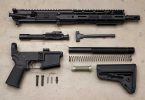



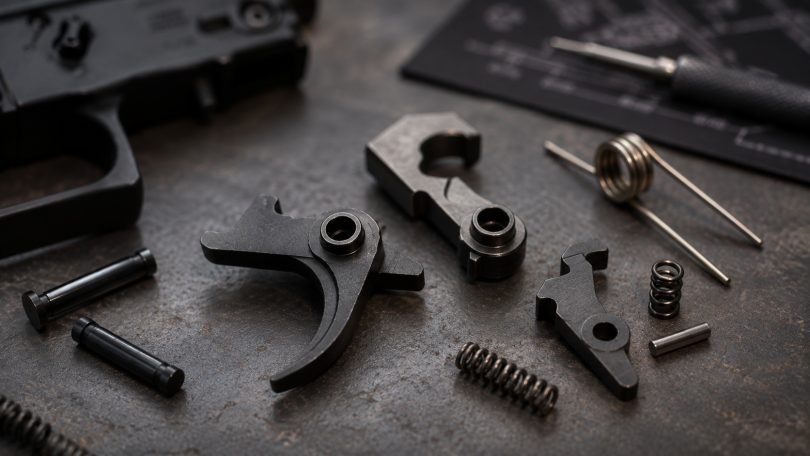

A fire control group (FCG) is the collection of internal firearm components responsible for controlling when the hammer or striker is released to fire the gun. In an AR-15, the term usually refers to the trigger, hammer, disconnector, and their associated springs and pins.
It sounds complicated. It really isn’t.
When you press an AR-15 trigger, you’re interacting with a small group of parts that hold the hammer under spring tension, release it when the trigger is deliberately pressed, and capture it again as the action cycles.
Understanding those parts makes a lot of AR terminology easier to follow.
What Does a Fire Control Group Do?
The fire control group manages the mechanical sequence between pulling the trigger and releasing the hammer.
In a typical semiautomatic AR-15, its basic jobs are to:
- Hold the hammer in the cocked position
- Release the hammer when the trigger is pressed
- Catch the hammer as the action cycles
- Return control of the hammer to the trigger mechanism
- Prepare the firearm for the next deliberate trigger press
That last point matters.
A standard semiautomatic AR-15 fires one round for each separate function of the trigger. The fire control group works with the cycling action to reset the mechanism between shots.
What Parts Make Up an AR-15 Fire Control Group?
When someone talks about an AR-15 fire control group, they’re generally talking about several components located inside the lower receiver.
Trigger
The trigger is the part the shooter physically presses.
Internally, it interfaces with the hammer and helps retain it in the cocked position until the trigger is pressed.
The geometry and surface characteristics of these interacting components have a major influence on how the trigger feels.
Hammer
The hammer is held under spring tension until the trigger mechanism releases it.
Once released, it rotates forward and strikes the firing mechanism.
As the bolt carrier cycles, the hammer is pushed back into the fire control mechanism.
Disconnector
The disconnector is one of the less visible, but important, parts of a semiautomatic AR fire control group.
During cycling, it temporarily captures the hammer when appropriate. As the trigger resets, control of the hammer transitions back into the normal ready condition.
That’s part of what allows the rifle to be ready for another deliberate trigger press without simply following the bolt carrier forward.
Springs
Several springs provide the tension required for the system to operate.
These commonly include the:
- Trigger spring
- Hammer spring
- Disconnector spring
They’re small parts, but their characteristics affect how the mechanism behaves.
Trigger and Hammer Pins
The trigger and hammer rotate around transverse pins installed through the lower receiver.
You’ll often hear these referred to simply as trigger pins or fire control pins.
Where Is the Fire Control Group Located?
On an AR-15, the fire control group sits inside the lower receiver.
Remove the upper receiver and look down into an assembled lower and you’re looking at the area containing the trigger mechanism, hammer, selector, and related components.
This is why discussions about AR lowers frequently involve terms such as:
FCG pocket — the internal area of the lower where fire-control components reside.
Trigger pins — the pins supporting components of the fire control group.
Safety selector — the control that interacts with the trigger mechanism to prevent normal trigger movement when placed on SAFE.
Fire Control Group vs. Trigger: Are They the Same Thing?
Not exactly.
People frequently use the terms interchangeably, especially when shopping for aftermarket AR triggers.
Technically, the trigger is one component of the fire control group.
The fire control group describes the larger mechanism.
That’s why you’ll see products marketed as both “AR-15 triggers” and “fire control groups.” Depending on the product, you’re buying more than the physical trigger shoe your finger touches.
Mil-Spec-Style vs. Aftermarket Fire Control Groups
The basic job doesn’t change, but trigger systems can feel dramatically different.
A traditional AR trigger uses individual components installed into the lower receiver. Aftermarket manufacturers also offer self-contained trigger assemblies commonly called drop-in triggers or cassette triggers.
Differences can include:
- Trigger pull characteristics
- Amount of take-up
- Break characteristics
- Overtravel
- Reset
- Trigger shape
- Single-stage or two-stage operation
The trade-off with increasingly specialized trigger systems is that better feel doesn’t automatically make a particular trigger better for every rifle.
A trigger intended for precision shooting may prioritize different characteristics than one selected for a straightforward general-purpose rifle.
The application matters more than the marketing language.
What Is a Single-Stage Trigger?
A single-stage trigger generally moves through its pull without a deliberately distinct second stage before the break.
The shooter applies pressure until the trigger reaches the point where the hammer is released.
Many traditional AR triggers fall into this general category.
Aftermarket single-stage triggers can provide substantially different pull characteristics, but “single-stage” by itself doesn’t tell you whether a trigger is good.
What Is a Two-Stage Trigger?
A two-stage trigger deliberately divides the trigger pull into two perceptible portions.
The shooter moves through the first stage before encountering a more defined second stage leading to the break.
This design is popular in applications where the shooter wants more feedback while preparing a precise shot.
Neither system is universally superior.
A shooter who prefers a simple, consistent pull may favor a single-stage design. Someone shooting from supported positions at distance may appreciate the additional feedback of a two-stage trigger.
Why Trigger Reset Matters
You’ll hear reset constantly when people discuss AR triggers.
After a shot, the trigger mechanism must return far enough to become ready for the next trigger press.
The movement and feedback associated with that process are commonly described as the trigger’s reset.
Some triggers provide very noticeable tactile and audible feedback. Others are more subtle.
A short reset can feel fast, but shorter isn’t automatically better. Predictability and control matter more than chasing the smallest possible number.
Is the Safety Selector Part of the Fire Control Group?
Terminology varies.
The selector directly interacts with the AR’s trigger mechanism, so it is closely associated with the fire control system. However, when manufacturers sell an “AR-15 fire control group,” the selector may or may not be included.
That’s why it’s worth checking exactly what’s included rather than assuming every FCG package contains the same components.
Why the Fire Control Group Matters
It’s easy to obsess over barrels, bolt carrier groups, optics, handguards, and every other visible component on an AR.
The fire control group doesn’t get the same attention until you actually shoot the rifle.
Then you notice it immediately.
Trigger characteristics affect how easily a shooter can apply pressure without disturbing the rifle, how clearly the break can be anticipated, and how the trigger feels as it resets.
That doesn’t mean every AR needs an expensive aftermarket trigger.
A basic trigger that functions correctly may be entirely appropriate for a general-purpose rifle. More specialized triggers become attractive when their characteristics solve a specific problem or better fit the intended use.
The Bottom Line
The fire control group is the mechanical system that controls the release and recapture of the hammer in an AR-15.
At its core, you’re dealing with a trigger, hammer, disconnector, springs, and supporting components working together inside the lower receiver.
You don’t need to memorize every interaction to understand an AR-15.
But knowing what the fire control group does gives you the foundation for understanding trigger terminology, single-stage versus two-stage designs, trigger reset, and why two AR-15s can feel completely different even when the rifles otherwise look nearly identical.