



The standard AR-15 bolt carrier group has been doing its job for a long time.
So when a company starts adding dual ejectors, sand cuts, different venting options, multiple bolt steels and enough finishes to make the product page look like a paint catalog, the obvious question is:
What are you actually getting that a normal BCG doesn’t already do?
That’s the interesting part of KAK Industry’s K-SPEC lineup.
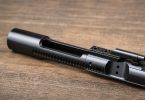
The K-SPEC isn’t one single bolt carrier group. It’s a family of enhanced BCGs built around different combinations of features, including side-vent and down-vent carriers, dual- and single-ejector bolts, sand-cut and standard carrier rails, multiple bolt materials and a long list of finish options.
Some of those features solve very specific problems.
Some are more about preference.
And some are probably more useful on one rifle than another.
So rather than treating the K-SPEC like one giant upgrade package, it makes more sense to break down what actually changes.
What Is the KAK K-SPEC BCG?
The K-SPEC is KAK Industry’s enhanced AR-15 bolt carrier group line.
Depending on the exact model, you may find:
- Traditional side vents or downward-facing vents
- Single or dual ejectors
- Sand-cut or standard carrier rails
- 9310 or Carpenter 158 bolts
- Chrome-lined carrier bores and gas keys
- A gasket between the gas key and carrier on applicable K-SPEC carriers
- Phosphate, hard chrome, NP3, DLC, PVD and other finish options
- Configurations for multiple AR-15 calibers
That’s an important distinction because two people can both say they’re running a K-SPEC and be talking about noticeably different BCGs.
One might have a traditional side-vent carrier with sand cuts and a dual-ejector bolt.
Another might have a down-vent carrier with standard rails and a single-ejector bolt.
Same family. Different priorities.
K-SPEC Enhanced vs. K-SPEC-S
KAK has expanded the lineup beyond the original enhanced carrier design.
The standard K-SPEC Enhanced models are commonly associated with sand cuts and enhanced bolt options.
The newer K-SPEC-S line gives shooters another route by using standard carrier rails rather than the sand-cut design while still offering other K-SPEC features, including down-vent options and different ejector configurations.
That sounds like a small change, but it’s actually useful.
Not everyone who wants down venting also wants sand cuts.
Not everyone who wants a dual-ejector bolt cares about down venting.
And that’s where the K-SPEC lineup starts to make more sense: you’re not necessarily buying one fixed recipe anymore.
Side Vent vs. Down Vent
This is probably the biggest fork in the K-SPEC lineup.
Side-Vent K-SPEC
The side-vent version keeps the more traditional AR carrier vent arrangement while still giving you access to other K-SPEC features such as dual ejectors, sand cuts and different finishes.
That makes sense for someone who wants the enhanced carrier features without changing where the carrier exhaust is directed.
It’s the less dramatic option.
And that’s not necessarily a bad thing.
Down-Vent K-SPEC
The down-vent carrier redirects carrier exhaust downward instead of out the side of the BCG.
That design gets most of the attention because it can change how a suppressed rifle feels around the ejection-port area, particularly for left-handed shooters.
KAK has also reported a change in suppressed sound signature during testing compared with a conventional side-vent carrier.
One obvious question is where all of that gas and fouling goes if the vents are pointed toward the magazine.
KAK has tested the design using transparent magazines to observe what happens below the carrier. According to the company, the down-vent configuration did not produce additional debris accumulation in the magazine compared with conventional configurations.
That’s worth addressing because moving the exhaust ports downward can sound like you’re simply trading gas at the ejection port for a dirtier magazine. KAK’s testing suggests that isn’t what happens, although that’s manufacturer testing rather than independent long-term testing across every rifle and suppressor combination.
But down venting is still a specific feature solving a specific problem.
It does not automatically make it the better choice for every rifle.
If you shoot unsuppressed, don’t have an issue with gas around the ejection port and aren’t trying to change port noise, traditional side venting may make just as much sense.
What Do Dual Ejectors Actually Do?
Traditional AR-15 bolts use one spring-loaded ejector.
KAK offers K-SPEC bolts with two.
The idea is pretty simple: more consistent and more forceful ejection.
Some K-SPEC users report extremely consistent brass ejection with the dual-ejector setup, and the design can make more sense in cartridges or operating conditions where stronger ejection is useful.
That doesn’t mean a single-ejector 5.56 bolt suddenly stopped working.
A quality traditional bolt has been doing this job successfully for decades.
Dual ejectors are better viewed as an additional reliability-oriented feature rather than something every AR absolutely needs.
KAK offering both single- and dual-ejector versions is probably the more sensible approach.
What Are Sand Cuts?
Sand cuts remove sections of the carrier’s bearing surfaces.
The idea is to create space for dirt, carbon or debris instead of letting contamination become trapped between a full-length carrier rail and the upper receiver.
This isn’t a concept KAK invented, and variations of sand-cut carriers have existed elsewhere in the AR world.
The feature makes sense on paper.
It has also generated some debate.
There are user reports of visible wear where sand cuts contact upper receivers, including some criticism of sharp edges on individual carriers.
Other owners report substantial round counts without meaningful problems.
That doesn’t give us enough evidence to declare sand cuts either essential or universally harmful.
It does give buyers something worth inspecting.
If you want the debris-clearing concept, the enhanced sand-cut carrier is there.
If you don’t see the need, the K-SPEC-S line gives you standard carrier rails instead.
Choice is better than pretending one answer works for everyone.
9310 vs. Carpenter 158
This debate follows AR-15 bolts everywhere.
KAK offers both 9310 and Carpenter 158 bolt options in parts of the K-SPEC lineup.
Carpenter 158 has the long military-spec pedigree and remains the material many buyers automatically look for.
9310 is also widely used in AR bolts and can perform extremely well when the bolt is properly manufactured and heat treated.
That’s the part that tends to get lost in internet arguments.
The name of the steel doesn’t tell you everything about the finished bolt.
Heat treatment, dimensions, machining, material quality and overall manufacturing all matter.
KAK has stated that it sells more 9310 than C158 and that its own internal testing has not produced bolt failures from either material.
That’s manufacturer-reported testing, not independent proof that the two materials are identical in every situation.
Still, it’s enough to make the usual “C158 good, 9310 bad” argument look overly simplistic.
If you specifically want C158 because of its long track record, buy C158.
If the rest of the bolt is well made, 9310 shouldn’t automatically disqualify it.
Phosphate, Chrome, NP3, DLC and PVD
This is where the K-SPEC lineup starts becoming a little ridiculous.
In a good way.
There are a lot of finish options.
Phosphate
Phosphate is the old reliable answer.
It’s proven, relatively inexpensive and has been used successfully on AR bolt carrier groups for decades.
The tradeoff is mostly cleaning.
Its rougher surface tends to hold carbon more stubbornly than slicker finishes.
Not exciting.
Still effective.
Hard Chrome
Hard chrome gives you a hard, corrosion-resistant surface that’s generally much easier to wipe clean than phosphate.
It’s also easy to inspect because fouling stands out against the bright surface.
And yes, people buy chrome because it looks good too.
That’s allowed.
NP3
NP3 is one of the slicker finish options in the K-SPEC lineup.
It gets a lot of attention from suppressed shooters because slicker surfaces tend to make dirty parts easier to clean.
It also costs more.
Does your AR need NP3 to run?
No.
Can it make maintenance more pleasant?
That’s a much better argument.
DLC and PVD
DLC and PVD finishes offer harder, smoother surfaces than traditional phosphate and can make cleanup easier.
Some of KAK’s PVD options also exist partly because people want something other than black or silver inside the rifle.
There’s nothing wrong with admitting aesthetics matter.
A firearm component can work well and still look good.
The Internal Chrome Lining Matters More Than the Exterior Color
It’s easy to focus on the outside finish because that’s the part you can actually see.
But the carrier’s internal surfaces matter more to long-term operation.
KAK uses chrome lining in areas such as the carrier bore and gas key on its coated carriers.
That’s worth paying attention to because not every coated BCG on the market handles internal surfaces the same way.
The exterior finish gets the photos.
The internal surfaces are where some of the important wear and gas sealing actually happen.
There’s Another Small Gas-Sealing Detail
KAK also uses a gasket between the gas key and carrier on applicable K-SPEC carriers.
It’s not the kind of feature that gets as much attention as dual ejectors or down venting, but the purpose is straightforward: improve the seal at the interface between the gas key and carrier and reduce the potential for gas leakage there.
A properly installed conventional gas key can already seal and function reliably, so this isn’t something an AR suddenly needs in order to work.
It’s better viewed as another example of the K-SPEC approach: taking an established BCG design and adding small changes intended to tighten up particular areas rather than reinventing the entire system.
What About K-SPEC Quality-Control Complaints?
You can’t research the K-SPEC for very long without finding complaints.
There have been user reports involving rough sand cuts, premature wear, gas-ring issues, bent retaining pins and other individual problems.
There are also owners reporting thousands of suppressed rounds without meaningful failures.
That’s not enough to responsibly jump from “some people had problems” to “the entire product line has bad quality control.”
Internet gun discussions tend to move from:
“One guy had a problem.”
to:
“Everyone knows these are garbage.”
with impressive speed.
One example involved what appeared to be chrome flaking inside an NP3-coated carrier.
KAK responded that the material was NP3 overspray inside the chrome-lined bore. According to the company, the NP3 could not properly adhere to the chrome and would wear away during use rather than representing failing chrome lining.
That explanation makes the situation very different from actual chrome separation.
It also doesn’t mean every complaint should be dismissed.
Inspect the part you actually receive.
Look at the carrier rails, gas key, bolt, ejectors and internal surfaces.
Judge real defects as real defects.
Just don’t let either company marketing or internet outrage make the decision before you’ve looked at the evidence.
Who Is the K-SPEC Actually For?
This is where the lineup makes more sense than trying to ask whether the K-SPEC is simply “better” than mil-spec.
You Want a Traditional Carrier With Extra Features
The side-vent K-SPEC gives you a more familiar vent arrangement while still letting you choose features such as sand cuts, dual ejectors and upgraded finishes.
That’s probably the most straightforward K-SPEC configuration.
You Shoot Suppressed
The down-vent version becomes much more interesting here because carrier exhaust and port noise matter more once suppressor backpressure enters the equation.
That topic deserves its own discussion because rifle tuning, suppressor design and gas-system configuration all affect the outcome.
You’re Left-Handed
Left-handed shooters have a particularly obvious reason to look at down venting.
Your face is sitting much closer to the ejection-port side of a conventional right-handed AR.
Changing where carrier exhaust goes can therefore matter more than it does for a right-handed shooter.
You Want Easier Cleaning
If you’re less interested in vent geometry and more interested in wiping carbon off without spending half your evening scrubbing, chrome, NP3 and some of the harder modern coatings may be the features you actually care about.
You Just Want a Reliable Unsuppressed AR
This is where things get much less exciting.
If your current rifle runs reliably with a quality conventional BCG, you may not have a problem that requires a K-SPEC.
That doesn’t make the enhanced features useless.
It just means they’re optional.
And optional is fine.
Is the KAK K-SPEC BCG Worth It?
The K-SPEC lineup makes more sense once you stop treating it like one product.
A side-vent phosphate K-SPEC and a down-vent NP3 K-SPEC may technically share a name, but they’re appealing to different priorities.
The useful question isn’t:
“Is the K-SPEC better than mil-spec?”
It’s:
“Which K-SPEC features actually solve something on my rifle?”
If you want stronger or more consistent ejection, dual ejectors may be interesting.
If you want easier cleaning, finish choice may matter more than anything else.
If you want debris channels around the carrier rails, sand cuts may appeal to you.
If you shoot suppressed and care about where carrier gas exits, the down-vent version becomes the one worth examining.
If none of those things matter to you, a good conventional BCG remains extremely difficult to argue with.
The Bottom Line
The KAK K-SPEC isn’t one magic bolt carrier group that’s automatically superior to everything that came before it.
It’s a modular family of BCGs built around a bunch of different ideas.
Some of those ideas are genuinely useful in the right rifle.
Some are preference.
Some are probably unnecessary for most shooters.
That’s actually what makes the lineup interesting.
You can choose side vent or down vent.
Single or dual ejectors.
Sand cuts or standard rails.
9310 or C158.
Phosphate, chrome, NP3 and several other finishes.
The trick is not convincing yourself that every extra feature automatically makes the BCG better.
Figure out what problem you’re trying to solve first.
Then choose the version that actually addresses it.



Leave a Comment