


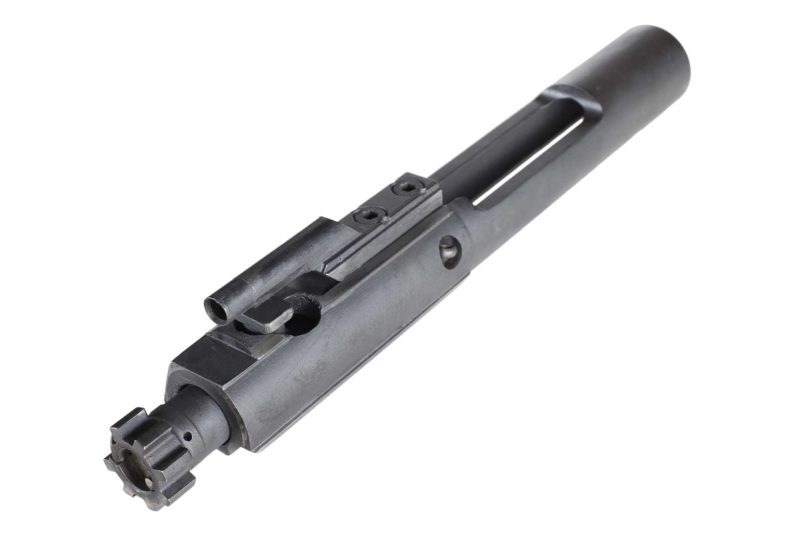

If you strip an AR-15 down to the components that actually make it function, one part consistently sits at the center of reliability, cycling, and performance: the bolt carrier group.
For many new builders and buyers, the bolt carrier group (often shortened to BCG) is something they recognize but don’t fully understand. It sits inside the upper receiver, it moves when the rifle fires, and it’s often described as “important”—but that doesn’t explain what it actually does or why it matters.
To understand the role of the BCG, you need to place it inside the broader system. The AR-15 is not a collection of independent parts—it’s a coordinated mechanical platform. That’s why concepts like AR platform fundamentals matter before focusing on individual components.
This article defines what a bolt carrier group is, explains its role in the firing cycle, and shows how it fits into the overall function of the rifle. It does not attempt to fully break down every internal component or mechanical interaction—that’s covered in more specialized pages—but it gives you the structural understanding needed to make sense of the platform.
What a Bolt Carrier Group Is
A bolt carrier group is the self-contained assembly inside an AR-15 that handles chambering, locking, firing support, extraction, and cycling.
It is not a single part, but a group of components working together as a unit. While detailed breakdowns exist elsewhere, the important point here is that the BCG acts as the primary moving mechanism responsible for managing the cartridge during operation.
Within the rifle, the BCG sits inside the upper receiver, interacting directly with the barrel, chamber, and gas system. If you’ve reviewed an AR-15 parts overview, the BCG stands out as one of the core moving assemblies that ties multiple systems together.
To understand its role clearly, it helps to compare it with other major structural components. The difference becomes easier to grasp when you understand the difference between upper and lower receivers, because the BCG operates entirely within the upper while still depending on the lower for support and reset.
How the Bolt Carrier Group Fits in the AR System
The bolt carrier group does not operate independently. It functions as part of a coordinated system that includes the barrel, gas system, and buffer assembly.
When a round is fired, gas is redirected back into the system. That energy drives the BCG rearward, initiating the cycling process. This relationship is why understanding AR-15 gas system function is critical—the BCG depends entirely on that energy to move.
The full sequence of operation is outlined in the ar15 cycle of operations, where each stage relies on the movement of the bolt carrier group. Without that movement, the system cannot complete its cycle.
From a structural standpoint, the BCG is where energy transfer becomes mechanical action. It translates gas pressure into motion that performs specific tasks in a precise order.
What the Bolt Carrier Group Actually Does
Rather than focusing on individual parts, it’s more useful to understand the BCG in terms of what it does during operation.
- Moves forward to chamber a round
- Locks the bolt into the barrel extension
- Supports the firing process
- Unlocks after the shot is fired
- Extracts and ejects the spent casing
- Cycles rearward to reset the system
Each of these actions occurs in sequence, and each one depends on precise timing. This is why more detailed breakdowns—such as how the bolt carrier group works—focus heavily on movement and interaction between components.
The key takeaway is simple: the BCG is responsible for executing the physical actions that allow the rifle to function repeatedly and consistently.
Relationship to the Rifle Cycling Process
The cycling process of an AR-15 is often discussed as a system, but in practical terms, it is carried out by the bolt carrier group.
When you look at how AR rifles cycle, what you’re really observing is the movement of the BCG in response to gas pressure and spring tension.
This relationship becomes more apparent when comparing operating systems. The distinction between direct impingement vs piston systems highlights how different designs still rely on the BCG to complete the same fundamental tasks.
Regardless of the system used, the BCG remains the component that performs the work.
Why the Bolt Carrier Group Matters for Reliability
Not all components contribute equally to reliability. The bolt carrier group is one of the highest-impact parts in the entire platform.
Because it handles pressure, movement, and timing, even minor issues can lead to failures. Many problems traced back to common AR build mistakes involve the BCG—whether due to poor material quality, incorrect assembly, or compatibility mismatches.
From a practical standpoint, the BCG influences:
- Consistency of cycling
- Extraction and ejection reliability
- Wear over time
- Overall system durability
This is why it is often treated as a priority component during both builds and upgrades.
Compatibility and System Fit
The AR platform is modular, but it is not random. Parts are designed to work together within certain parameters.
The bolt carrier group must match the overall configuration of the rifle. Gas system length, buffer weight, and spring tension all influence how it performs. This is why understanding AR-15 parts compatibility basics is essential once you move beyond basic definitions.
The idea of modular rifle design explains why parts can be swapped—but also why they still need to function as a system.
The BCG sits at the center of that balance.
Where the BCG Sits in the Platform
The bolt carrier group is located inside the upper receiver, directly behind the barrel and chamber.
It interfaces with multiple components and acts as a bridge between systems. To understand its placement more clearly, it helps to review what an upper receiver does and what a lower receiver is.
While it physically resides in the upper, its movement is influenced by components in the lower, particularly the buffer system. This interaction reinforces the idea that the AR-15 is a connected platform rather than a set of isolated parts.
Performance Considerations and Upgrades
The bolt carrier group is one of the most commonly evaluated components when building or upgrading a rifle.
Not because it changes the system’s design—but because it directly affects durability, wear, and consistency.
If you’re comparing options, best bolt carrier groups and the bolt carrier group buying guide provide structured evaluations of different configurations.
For builds focused on long-term use, best BCG for reliability highlights options designed for consistent performance under sustained conditions.
The important point is that the BCG is not just a background component—it is a key decision point that influences how the rifle performs over time.
Frequently Asked Questions
What does a bolt carrier group do in an AR-15?
The bolt carrier group manages chambering, locking, firing support, extraction, and cycling by converting gas pressure into mechanical movement.
Is the bolt carrier group the same as the bolt?
No. The bolt is one part inside the bolt carrier group. The full assembly includes the carrier and other components.
Where is the bolt carrier group located?
It is located inside the upper receiver, directly behind the barrel and chamber.
Does the bolt carrier group affect reliability?
Yes. It plays a major role in timing, extraction, and cycling consistency.
Can you upgrade a bolt carrier group?
Yes. Many users upgrade for improved durability, coatings, and long-term performance.
Is the bolt carrier group a serialized part?
No. The lower receiver is the serialized component in most AR-15 configurations.
Conclusion
The bolt carrier group is the mechanism that turns the AR-15 from a static structure into a functioning system.
It connects gas pressure to motion, executes the steps of the firing cycle, and bridges multiple parts of the platform into a coordinated process.
Understanding its role makes it easier to evaluate builds, diagnose issues, and make informed decisions about upgrades. Once you understand the BCG, the rest of the system becomes easier to interpret—not as separate parts, but as a unified design built around controlled mechanical movement.