



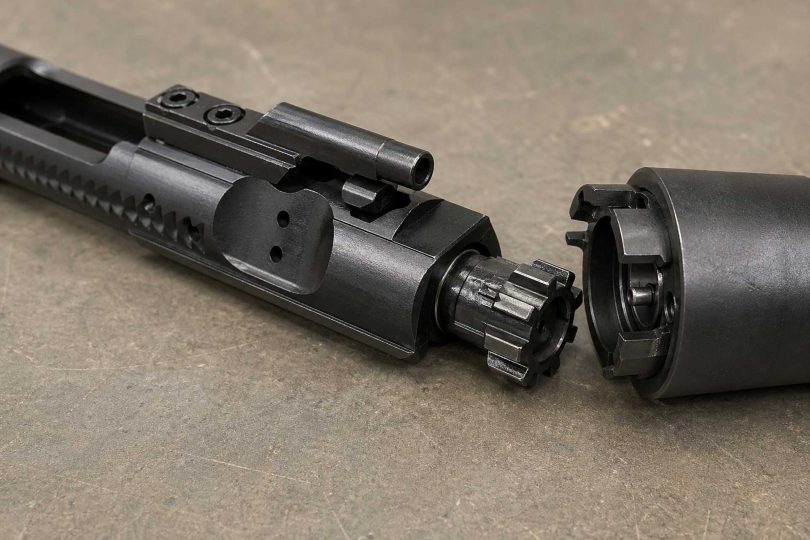

Headspace is one of those terms that gets mentioned often in technical discussions but rarely explained in a way that connects directly to how an AR-15 actually functions. It’s not a visible part, and it’s not something you adjust casually, but it plays a critical role in whether a rifle operates safely and reliably.
At its simplest, headspace defines the relationship between the bolt, the cartridge, and the chamber. That relationship determines whether a round seats correctly, whether pressure is contained properly, and whether the rifle cycles without introducing unnecessary wear or risk. Understanding it is less about memorizing a measurement and more about understanding how tolerances work across the system.
To see where headspace fits, it helps to start with the broader mechanical sequence of the rifle. The AR-15 cycle of operations shows how each stage—from feeding to locking to firing—depends on precise alignment between components. Headspace sits directly inside that sequence, influencing the moment when the bolt locks and pressure is contained.
This article breaks down what headspace actually is, why it matters, and how it fits into the AR-15 platform as a system—not just a measurement.
What Headspace Actually Means in an AR-15
Headspace refers to the distance between the bolt face and a defined point in the chamber that stops the forward movement of a cartridge. In an AR-15, that point is typically located along the shoulder of the chamber for bottleneck cartridges like 5.56 NATO or .223 Remington.
Unlike external parts, headspace is not something you see. It’s a relationship formed between:
- the bolt face
- the locking lugs
- the barrel extension
- the chamber geometry
When the bolt rotates into position during the bolt locking and unlocking process, those components create a sealed environment for the cartridge. Headspace determines whether that seal is correct.
This is why headspace is not adjusted independently on an AR-15. It is a product of how the bolt and barrel interface. The design of the platform—especially its modular nature, as explained in modular rifle design explained—means parts are often swapped, but headspace remains dependent on how those parts fit together within tolerance.
Why Headspace Matters for Safety and Function
Headspace matters because it directly affects how pressure is managed when a round is fired. If the relationship between the bolt and chamber is incorrect, the system can either fail to contain pressure properly or create unnecessary stress on components.
From a functional standpoint, the AR-15 relies on precise timing and pressure to operate. The rifle cycling process depends on controlled gas expansion and mechanical movement. Headspace influences the starting point of that process.
From a safety standpoint, incorrect headspace can:
- allow the cartridge to move too far forward
- prevent proper sealing of the chamber
- increase stress on the case and bolt
That’s why headspace is tied not just to reliability, but to the integrity of the entire system. It’s also why compatibility matters—something covered in AR-15 parts compatibility basics—because mismatched components can affect how those tolerances stack.
Tight vs Loose Headspace: What Changes
Headspace is not simply “correct” or “incorrect.” It exists within an acceptable range, and performance changes depending on where within that range a rifle falls.
Tight Headspace
- Bolt sits closer to the chamber reference point
- Can improve consistency
- May reduce tolerance for variation in ammunition
- Can increase resistance during chambering
Loose Headspace
- Bolt sits slightly farther from the chamber reference point
- Allows more variation in ammunition
- May increase wear over time
- Can affect how pressure is distributed
Neither extreme is ideal. The goal is to remain within specification while balancing reliability and durability.
This balance becomes clearer when you look at how gas pressure drives the system, as outlined in how the AR-15 gas system works. Headspace doesn’t control gas directly, but it affects how pressure is contained before gas begins driving the bolt rearward.
Where Headspace Fits in the AR-15 System
Headspace doesn’t operate in isolation. It sits at the intersection of several systems:
Bolt Carrier Group
The bolt locks into the barrel extension and forms the seal. The overall function is explained in how the bolt carrier group works, but headspace defines how that seal is established.
Barrel and Chamber
The chamber determines where the cartridge stops. Variations in chamber dimensions influence headspace within acceptable limits.
Gas System and Timing
Gas begins flowing after the bullet passes the gas port. The timing relationship is explored in AR-15 dwell time explained, which shows how pressure continues acting on the system after ignition.
Lower Receiver and Buffer System
While the lower doesn’t directly affect headspace, it influences how forces are absorbed. The role of the lower is explained in how a lower receiver works, and the buffer system further shapes recoil and cycling behavior.
Common Situations Where Headspace Becomes Relevant
Most factory rifles are built within specification, so headspace is rarely something a casual owner needs to measure. However, it becomes relevant in specific scenarios:
Mixing Bolts and Barrels
Swapping components across manufacturers can introduce tolerance stacking. This is where understanding compatibility matters more than individual parts.
High Round Counts
Wear over time can slightly change how components interact, especially in high-use rifles.
Troubleshooting Reliability
Issues that seem like gas or cycling problems may actually originate from how the bolt and chamber interface.
This is why headspace often appears in discussions alongside troubleshooting resources like the bolt carrier group troubleshooting guide, even though it’s not usually the first variable people check.
How Headspace Affects Build Decisions
For builders, headspace is less about adjustment and more about selection. The AR-15 platform is designed for modularity, but that modularity depends on consistent standards.
When selecting parts:
- Use quality bolts and barrels from reputable manufacturers
- Avoid mixing unknown or out-of-spec components
- Understand that tolerances stack across parts
This is where decision-focused pages—like best bolt carrier groups—become relevant. They don’t just compare features; they indirectly influence how well components work together.
Similarly, complete systems like complete AR build kits reduce compatibility risk by keeping components matched from the start.
What Headspace Is Not
A common misconception is that headspace is something you tune like gas or buffer weight. It’s not.
Headspace is:
- not a performance upgrade
- not a tuning parameter
- not a user-adjustable feature
It is a fixed relationship determined by how parts are manufactured and how they interface.
This distinction matters because it keeps expectations aligned. The AR-15 allows adjustment in areas like gas flow or recoil management, but headspace remains a foundational constraint.
FAQ: AR-15 Headspace Explained
What is headspace in an AR-15?
Headspace is the distance between the bolt face and the point in the chamber that stops the cartridge, determining how the round is positioned before firing.
Why does headspace matter?
It ensures proper pressure containment and reliable function. Incorrect headspace can affect both safety and performance.
Can headspace be adjusted?
No. It is determined by the relationship between the bolt and barrel, not something tuned through external adjustments.
When should headspace be checked?
It becomes relevant when mixing bolts and barrels, diagnosing unusual issues, or working with high-use components.
Does headspace affect reliability?
Yes. Improper headspace can lead to inconsistent chambering, pressure issues, or accelerated wear.
Is headspace the same across all AR-15s?
No. It exists within a tolerance range, and small variations are normal as long as they remain within specification.
Conclusion
Headspace is not a visible component or a user-controlled setting, but it plays a central role in how an AR-15 operates. It defines how the bolt and chamber interact, how pressure is contained, and how reliably the system functions over time.
Understanding headspace means understanding the limits of the platform. It clarifies why compatibility matters, why tolerances matter, and why certain problems can’t be solved through simple adjustments.
As you move from understanding individual parts to understanding how the rifle functions as a complete system, headspace becomes part of a larger picture—one that connects mechanical design, safety, and long-term reliability.
And that’s ultimately where it belongs: not as a standalone concept, but as a structural element inside the AR platform as a whole.





Leave a Comment