



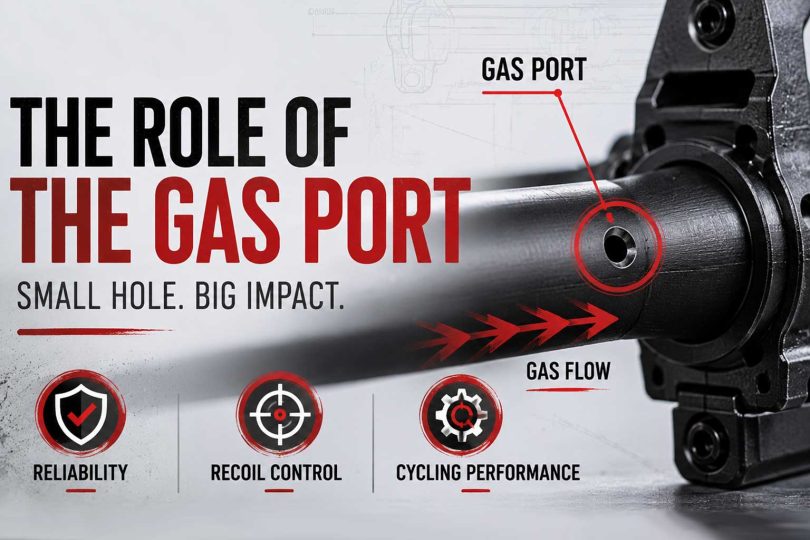

An AR-15’s gas port is a small hole drilled into the barrel, but its influence over rifle behavior is much larger than its size suggests. Gas port sizing affects how aggressively the rifle cycles, how much recoil impulse the shooter feels, how reliably the bolt carrier moves under different conditions, and how forgiving the system remains when variables change.
For many builders, gas port size only becomes visible when something goes wrong. A rifle may feel unusually violent during recoil, eject brass inconsistently, fail to lock back on empty magazines, or become unreliable after adding a suppressor. These symptoms are often treated individually, but they are usually tied to timing and pressure management inside the operating system.
Understanding gas port sizing matters because the AR-15 is fundamentally a pressure-driven platform. The system depends on carefully timed gas flow to move the carrier group at the correct speed and duration. Too little gas and the rifle struggles to complete the cycling sequence. Too much gas and the rifle may function harshly, prematurely wear components, or become difficult to tune.
This is why understanding how the AR-15 gas system works becomes important before diagnosing reliability or recoil behavior. Gas port size is not an isolated specification. It interacts with barrel length, dwell time, ammunition pressure, suppressors, carrier weight, and buffer resistance simultaneously.
The subject is especially relevant for builders assembling custom uppers, shooters tuning rifles for suppressor use, or anyone trying to balance reliability with smoother recoil characteristics. At the same time, it is less important for casual owners using factory rifles within normal operating conditions, since most reputable manufacturers intentionally overgas rifles slightly to maximize reliability across ammunition types.
What Gas Port Size Actually Does
The gas port controls how much propellant gas is diverted from the barrel into the gas system. After a round is fired, the bullet travels down the barrel. When it passes the gas port, a portion of the expanding gas moves through that opening into the gas block, then through the gas tube, and eventually into the carrier system.
That redirected gas initiates the AR-15 cycle of operations, which includes unlocking, extraction, ejection, rearward carrier travel, spring compression, forward return, feeding, chambering, and locking. Gas port size influences how much energy is available to complete that sequence.
A larger gas port generally allows more gas into the system. That can improve reliability when conditions are marginal, but it can also increase bolt speed, recoil impulse, fouling, and component wear. A smaller gas port allows less gas into the system. That can create smoother cycling, but it also narrows the margin for weak ammunition, fouling, cold weather, or suppressor changes.
The important point is that gas port size is not “good” or “bad” by itself. It is only correct or incorrect relative to the rifle’s full operating system.
How Gas Port Size Affects Cycling
Cycling depends on pressure, timing, and resistance. Gas port size controls part of that pressure equation, but the result depends on how the rest of the rifle responds.
Once gas enters the carrier system, it drives the bolt carrier rearward. That movement must be strong enough to unlock the bolt, extract the casing, eject it, compress the buffer spring, and return forward with enough force to chamber the next round. This relationship is central to the rifle cycling process.
If the gas port allows too much gas into the system, the carrier may move faster than necessary. That can make recoil feel sharper and can increase stress on parts. If the gas port allows too little gas into the system, the carrier may not travel far enough to complete the cycle.
This is where many shooters confuse symptoms. A rifle can be reliable but harsh because it is overgassed. Another rifle can feel smooth but unreliable because it is undergassed. The goal is not the softest possible action. The goal is a reliable action with enough operating margin for the rifle’s intended use.
Gas Port Size, Dwell Time, and Barrel Length
Gas port size cannot be understood without dwell time. Dwell time is the period between the bullet passing the gas port and leaving the barrel. During that window, pressure continues feeding the gas system.
A short barrel with limited dwell time may need more gas availability to cycle consistently. A longer barrel or longer dwell window may not need as much port size because pressure is available for a longer period. This is why AR-15 dwell time explained is such an important companion topic.
Gas system length also matters. Carbine-length, mid-length, and rifle-length systems all change where the gas port sits on the barrel. That changes pressure level and timing. A gas port that works well in one configuration may be excessive or insufficient in another.
In practical terms, this means gas port sizing is a balancing act. It has to account for barrel length, gas system length, ammunition pressure, suppressor use, and the expected reliability margin.
Overgassed vs Undergassed Behavior
Gas port size is one of the major reasons a rifle may behave overgassed or undergassed. An overgassed rifle receives more operating energy than necessary. An undergassed rifle receives too little operating energy to cycle consistently.
Overgassed symptoms can include sharp recoil, forward ejection, excessive bolt speed, increased fouling, and accelerated wear. Undergassed symptoms can include weak ejection, short stroking, failure to feed, and failure to lock back on an empty magazine.
This is why diagnosing overgassed vs undergassed AR-15 behavior requires more than looking at one symptom. Ejection pattern, recoil feel, ammunition, suppressor use, buffer weight, and maintenance condition all matter.
Gas port size is often part of the cause, but it is rarely the only variable. Before assuming the port is the issue, the rifle should be evaluated as a system.
How the Bolt Carrier Group Responds to Gas Port Size
The bolt carrier group is where gas pressure becomes mechanical movement. Gas entering the carrier drives rearward motion, controls unlocking timing, and determines how forcefully extraction begins.
Understanding how the bolt carrier group works helps explain why gas port size affects reliability so directly. A larger port can increase carrier speed. A smaller port can reduce available movement. Neither outcome is automatically good or bad unless compared to the rifle’s intended operating range.
Gas sealing also matters. A properly sized gas port cannot compensate for leakage or weak component fit. Carrier key issues, worn gas rings, or poor alignment can reduce efficiency enough to create symptoms that look like insufficient port size. That is why gas key staking explained belongs in any serious reliability discussion.
When the carrier receives gas at the correct pressure and timing, the rifle cycles predictably. When the carrier receives too much or too little energy, the entire operating sequence changes.
Buffer System Interaction
The gas system pushes the carrier rearward, but the buffer system controls how that movement is resisted and returned. Gas port size and buffer setup must work together.
A larger gas port may require more resistance from the buffer system to keep carrier speed under control. A smaller gas port may require less resistance to avoid short stroking. This relationship is why AR-15 buffer system basics matters when interpreting gas port behavior.
Buffer weight, spring strength, receiver extension type, and carrier mass all influence how the rifle responds to gas. Even buffer tube types and differences can matter when parts compatibility or recoil behavior becomes inconsistent.
The common mistake is treating gas and buffer decisions separately. In reality, they are opposite sides of the same operating equation. Gas provides force. The buffer system manages that force.
Suppressors and Gas Port Behavior
Suppressors often increase back pressure, which sends more gas into the operating system. A rifle that feels balanced unsuppressed may become overgassed once a suppressor is added.
This does not mean the gas port is automatically wrong. It means the rifle’s operating environment changed. More gas pressure is now available, and the system may need additional tuning to stay balanced.
Suppressor use can increase fouling, carrier speed, gas blowback, and wear. In some rifles, a smaller effective gas setting or additional buffer resistance can help restore balance. In others, reliability across suppressed and unsuppressed use requires accepting some compromise.
This is also where operating system design matters. The behavior of direct impingement vs piston systems changes how gas and fouling are distributed, especially under suppressed conditions.
Compatibility and Build Decisions
Gas port size becomes especially important when building or modifying an upper receiver. Barrel length, chambering, gas system length, buffer setup, ammunition type, and intended suppressor use all influence the final behavior.
This is why AR-15 parts compatibility basics matter before assuming parts will work together simply because they fit. A rifle can be dimensionally compatible but still poorly balanced.
Builders often create problems by mixing components without considering system relationships. A light carrier, stiff spring, small gas port, weak ammunition, or heavy buffer may each be reasonable in isolation, but together they can produce unreliable cycling.
Many of these issues overlap with common AR build mistakes, especially when users chase recoil reduction before establishing reliability.
Troubleshooting Gas Port-Related Symptoms
Gas port size should not be the first thing blamed for every cycling issue. Start with observable symptoms, then work backward through the system.
If the rifle short strokes, fails to lock back, or ejects weakly, possible causes include gas leakage, gas block alignment, weak ammunition, excess buffer resistance, fouling, or a genuinely undersized gas condition. If the rifle ejects forcefully, recoils sharply, or beats up brass, possible causes include excessive gas, suppressor back pressure, light buffer resistance, or high-pressure ammunition.
A bolt carrier group troubleshooting guide can help separate carrier-related problems from broader gas system behavior. The bolt locking and unlocking process also helps explain why timing matters during extraction.
Maintenance should not be ignored. Carbon buildup, dry moving parts, and worn springs can imitate gas problems. Regular how to clean a bolt carrier group practices help remove avoidable variables before deeper diagnosis.
When Component Selection Matters
Most shooters do not need to chase unusual gas port specifications. A quality barrel from a reputable manufacturer, matched to a standard gas system and appropriate buffer setup, usually works well.
Component selection becomes more important when the rifle is being used suppressed, built around unusual barrel lengths, tuned for competition, or expected to run across a wide range of ammunition.
In reliability-focused builds, carrier quality can influence how consistently the rifle handles gas pressure. That is where pages like best BCG for reliability and best bolt carrier groups become useful after the operating principles are understood.
For broader selection logic, a bolt carrier group buying guide can help connect gas behavior, carrier design, coatings, and reliability expectations into a practical buying framework.
FAQ: AR-15 Gas Port Size Explained
What does gas port size do in an AR-15?
Gas port size controls how much gas is diverted from the barrel into the operating system. That gas drives the bolt carrier group and affects cycling speed, recoil feel, reliability, and wear.
Does a larger gas port make an AR-15 more reliable?
A larger gas port can improve reliability under weak or dirty conditions, but it can also increase recoil, bolt speed, fouling, and component wear. More gas is not always better.
Can gas port size cause an AR-15 to be overgassed?
Yes. If the gas port allows more gas than the system needs, the rifle can cycle too aggressively. This may cause sharp recoil, forward ejection, faster wear, and harsh operation.
Can gas port size cause short stroking?
Yes, but short stroking is not always caused by the gas port itself. Gas leakage, weak ammunition, gas block alignment, heavy buffers, fouling, or worn components can create similar symptoms.
Why does suppressor use affect gas port behavior?
Suppressors increase back pressure, which can send more gas into the operating system. This can make a normally balanced rifle behave overgassed when suppressed.
Should most shooters modify gas port size?
No. Most shooters should focus on proper component matching, buffer balance, ammunition selection, and maintenance before considering gas port changes. Gas port sizing is best understood as a system-level design factor.
Conclusion
Gas port size is one of the smallest physical details in an AR-15, but it has a major influence on how the rifle behaves. It affects how much pressure enters the operating system, how quickly the bolt carrier moves, how the rifle feels during recoil, and how much reliability margin the system has under changing conditions.
The key is understanding that gas port size does not work alone. It interacts with dwell time, barrel length, gas system length, suppressor use, ammunition pressure, buffer resistance, and carrier efficiency. A port size that works well in one configuration may feel harsh or unreliable in another.
This is why gas port sizing belongs inside the larger structure of AR platform fundamentals. The AR-15 is not just a collection of interchangeable parts. It is an operating system where pressure, timing, mass, and resistance must work together.
For most builders and shooters, the practical takeaway is simple: diagnose the whole system before blaming one part. When gas behavior is understood correctly, recoil tuning, reliability fixes, and component choices become much more predictable.




Leave a Comment