



The best camo pattern is not the one with the most realistic leaves, the most popular brand name, or the newest marketing campaign. The best camo pattern is the one that fits the terrain where it will actually be used.
That sounds simple, but it is where many hunters make the wrong decision. A pattern that disappears in dark hardwood timber can look too heavy in open grass. A marsh pattern that blends into reeds can stand out badly in a green forest. A snow pattern that works after a storm may be almost useless once the ground becomes patchy and muddy.
Camouflage is not about becoming invisible. It is about reducing contrast, breaking up the human outline, and matching the visual structure of the environment closely enough that game animals do not immediately separate the hunter from the background.
This guide explains the best camo patterns by terrain, including woodland, marsh, grassland, snow, rocky, and mixed environments. The goal is not to crown one universal winner. The goal is to help you choose camouflage based on where you hunt, what the terrain looks like, and how the season changes the background around you.
Why Terrain Matters More Than the Camouflage Brand
Camouflage brands matter, but terrain matters more. Realtree, Mossy Oak, MultiCam-style patterns, digital patterns, and traditional woodland designs all include useful options. The mistake is choosing a brand family before understanding the environment.
A good camouflage pattern does three things well. It matches the dominant color range of the terrain, it uses contrast at the right scale, and it breaks up the shape of the hunter’s body. If any of those elements are wrong, the pattern may look impressive up close while still performing poorly in the field.
This is why a broader understanding of types of camouflage patterns is useful before choosing a specific hunting pattern. Different camouflage categories solve different visibility problems. Some patterns mimic vegetation. Some rely on macro breakup. Some are designed for transitional terrain where the background changes across distance.
Camouflage Is About Disruption, Not Perfect Imitation
The most realistic-looking pattern is not always the most effective pattern. Human eyes tend to admire fine detail. Animals detect movement, outline, contrast, and unusual shapes within their environment.
A shirt covered in detailed leaves may look convincing in a product photo, but if the pattern forms one dark blob at 30 yards, it can still reveal the hunter’s position. A less realistic pattern with stronger breakup may perform better because it interrupts the outline of the shoulders, head, arms, and torso.
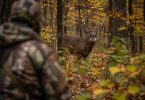
This is especially important in hunting situations where game may not be evaluating the exact pattern. Deer, turkey, ducks, and predators detect visual threats differently, but the same principle still applies: the pattern has to reduce recognition in the actual environment.
Color Matching Is Only Part of the Decision
Color matters, but it is not the whole system. A camo pattern can have the right green, brown, gray, or tan range and still fail if the contrast scale is wrong.
Dense hardwoods often include bark shadows, leaf litter, trunks, branches, and broken light. Marshes include vertical reeds, cattails, mud, water, and pale grasses. Open grasslands may have fewer shadows and more horizontal texture. Snow terrain may be bright, reflective, and low in visual complexity.
Each of those environments demands a different balance of color, contrast, and pattern shape. This is why a terrain-first approach is more reliable than simply asking which camouflage brand is best.
Movement Still Matters More Than Pattern
Even the best camouflage pattern cannot hide careless movement. A hunter wearing the right terrain-matched camo can still be detected if they shift too quickly, skyline themselves, expose bare skin, or move at the wrong moment.
Camouflage helps reduce visual detection. It does not replace fieldcraft. Positioning, background cover, shadows, wind, scent control, and patience still matter. For a deeper look at that question, the broader issue of hunting camouflage effectiveness is worth understanding before overvaluing any single pattern.
Understanding the Major Terrain Categories
Before comparing specific camo patterns, it helps to divide hunting terrain into practical visual categories. These categories do not have to be perfect. They simply help you choose camouflage based on the background you are trying to disappear into.
Dense Woodland and Hardwood Forests
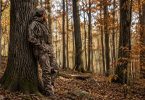
Woodland terrain usually includes tree trunks, branches, leaf litter, shadows, and uneven light. Depending on the region and season, the dominant colors may include dark brown, gray bark, green foliage, faded leaves, and black shadow pockets.
Good woodland camouflage usually needs enough contrast to break up the hunter’s body against trees and brush. Patterns that are too flat can turn into a single mass. Patterns that are too light can stand out in shaded timber.
Woodland terrain is one of the most common hunting environments, which is why a dedicated guide to woodland camouflage for hunting can go deeper into forest-specific pattern choices.
Marshes, Wetlands, and Waterfowl Habitat
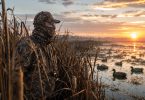
Marsh terrain has a different visual structure than timber. Instead of heavy bark, large shadows, and broad leaf shapes, marshes are often defined by vertical grasses, reeds, cattails, water, mud, and pale tan vegetation.
A dark woodland pattern may stand out badly in a marsh because the background is often lighter, more vertical, and more open. Effective marsh camouflage usually uses tan, brown, straw, and reed-like elements that match wetland vegetation.
This terrain is especially important for waterfowl hunters because blinds, boats, and clothing all need to match the same visual environment.
Open Grasslands and Prairie Terrain
Open grasslands can be difficult because there is often less cover to hide behind. The background may include dry grass, sage, brush, scattered shrubs, dirt, or low rolling terrain. Shadows may be less dramatic than in timber, and long sightlines can make movement easier to detect.
Grassland camouflage often needs lighter tans, muted browns, and open pattern structure. A dark forest pattern may create too much contrast. A high-detail leaf pattern may not match the simpler texture of grass and brush.
Mountain and Rocky Terrain
Mountain terrain varies widely. Some areas include timber, while others are dominated by rock, shale, alpine grass, scrub, or open slopes. The best camouflage depends on elevation, season, and whether the hunter is moving through timber, glassing from rocks, or crossing exposed terrain.
Rocky terrain often benefits from muted earth tones, gray-brown color ranges, and patterns that do not rely too heavily on leafy vegetation. The goal is to blend with stone, shadow, and sparse cover rather than dense forest growth.
Snow-Covered Environments
Snow changes everything. A standard woodland or marsh pattern may become too dark when the ground and surrounding cover turn white. Snow camouflage is designed to reduce contrast in bright environments while still providing enough breakup to avoid looking like a solid white shape.
However, snow terrain is not always pure white. Late-season conditions often include exposed bark, mud, dead grass, and patchy snow. That makes partial snow patterns or snow-over-layer systems useful when the environment is mixed rather than fully covered.
Mixed and Transitional Terrain
Many hunters do not hunt one clean terrain type. They may move between timber edges, brush lots, open fields, creek bottoms, cutovers, and agricultural land in the same day.
Mixed terrain is where transitional camouflage becomes useful. These patterns usually avoid being too specific. They may not be perfect in one environment, but they can perform reasonably well across several backgrounds.
This is where guides on multicam for hunting and camouflage selection by environment become helpful, because not every hunter needs a separate pattern for every terrain type.
Best Camo Patterns for Woodland Terrain
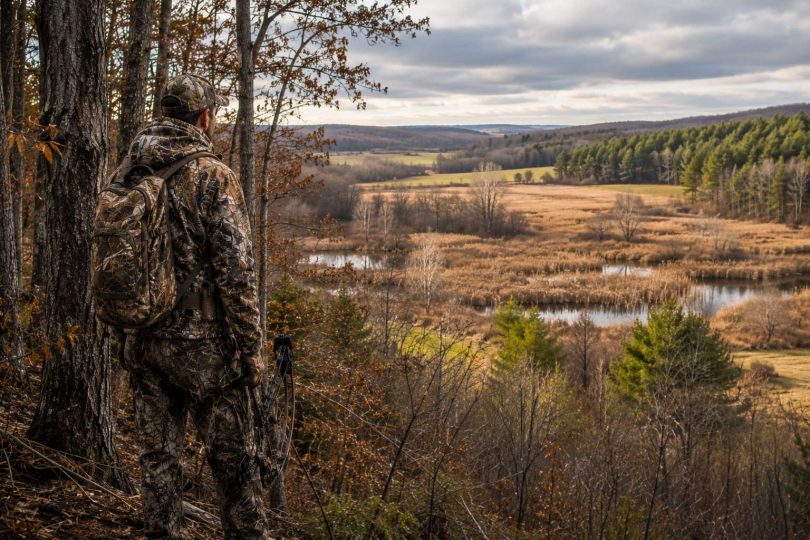
Woodland camouflage is built for forests, timber edges, brush, and shaded environments. It is one of the most useful categories for deer hunters, turkey hunters, small-game hunters, and anyone who spends most of their time around trees and leaf litter.
The best woodland camo patterns usually combine bark-like vertical shapes, leaf or branch elements, dark shadow areas, and medium-to-high contrast breakup. The exact pattern should depend on whether the woods are green, brown, open, dense, early season, or late season.
What Effective Woodland Camouflage Looks Like
Effective woodland camouflage usually has three visual traits.
First, it includes enough dark contrast to match tree shadows and bark structure. Forests are rarely flat and uniform. Even during green seasons, the background includes shaded trunks, limbs, and dark pockets of cover.
Second, it includes organic shapes that resemble forest texture without becoming too detailed. Leaves, branches, bark, and irregular blotches can all work if they break up the outline at realistic hunting distances.
Third, it avoids being too bright or too uniform. A pattern that looks sharp in a store can become too clean in the woods. A pattern that lacks contrast can become one solid shape when viewed from a distance.
Best Woodland Camo Situations
Woodland patterns usually perform best in hardwood forests, mixed timber, brushy ridges, oak flats, cedar edges, creek bottoms, and late-season leaf litter. They are especially useful when the hunter has a dark or textured background behind them.
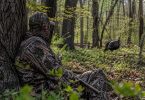
For stand hunters, woodland camo often works well when positioned against a tree trunk or inside natural cover. For ground hunters, the same pattern can help break up the body when sitting against brush, deadfall, or shaded terrain.
The biggest limitation is that woodland camouflage can become too dark in open fields, marsh grass, pale western terrain, or snow-covered environments. In those places, a forest pattern may create more contrast than concealment.
Woodland Pattern Selection Tips
Choose darker woodland patterns for shaded timber, thick hardwoods, and late-season forests with heavy bark contrast. Choose lighter woodland patterns for open woods, early fall, dry leaves, and areas where sunlight reaches the forest floor.
If your hunting area includes both timber and field edges, avoid extremely dark woodland patterns unless you are usually positioned inside the woods. A mid-tone woodland pattern often gives more flexibility across edges, trails, and mixed cover.
For a more focused breakdown, see the dedicated guide to woodland hunting camouflage, which narrows the discussion to forest-specific hunting conditions.
Best Camo Patterns for Marsh and Wetland Terrain
Marsh camouflage is designed around a completely different visual environment than woodland camouflage. Instead of dark tree trunks and heavy shadows, marshes are dominated by reeds, cattails, tall grasses, mud, shallow water, and light-colored vegetation.
This difference matters because camouflage that works extremely well in a hardwood forest may stand out dramatically in a duck blind or wetland edge. Marsh terrain often contains lighter colors, more vertical structure, and greater visual openness than timber.
Successful marsh camouflage matches these conditions rather than trying to imitate a forest environment.
Why Vertical Vegetation Matters
The defining feature of many marsh environments is vertical vegetation. Reeds, cattails, grasses, and brush grow upward in long narrow forms rather than creating the broad leaf structures commonly found in forests.
Effective marsh patterns often incorporate these vertical elements into the design. This helps the hunter blend into the background rather than appearing as a solid shape among narrow vegetation.
Patterns designed specifically for waterfowl environments often use tan, straw, brown, and muted green color palettes because these colors are commonly found around wetlands throughout the hunting season.
Characteristics of Effective Marsh Camouflage
Good marsh camouflage typically uses lighter colors than woodland camouflage. Many successful patterns emphasize tan and brown vegetation rather than dark greens and black shadows.
The goal is to match the dominant colors of reeds, dead grasses, cattails, and shoreline vegetation while maintaining enough contrast to break up the hunter’s outline.
Marsh patterns also tend to work best when combined with natural cover. Adding local vegetation to blinds, boats, and concealment setups often contributes more to concealment than changing between similar camouflage patterns.
Waterfowl Hunting Considerations
Waterfowl hunting presents unique camouflage challenges because hunters are often positioned in relatively open environments. Ducks and geese may approach from above, providing viewing angles that are less common in many other hunting situations.
This increases the importance of matching the surrounding vegetation and reducing obvious visual contrasts.
Hunters who spend significant time in wetlands should consider a dedicated pattern rather than relying on a woodland design. A deeper breakdown is available in marsh camouflage explained and best camo for duck hunting.
Best Camo Patterns for Open Grassland and Prairie Terrain
Open grassland environments create a different concealment challenge than either forests or marshes. Vegetation is often shorter, sightlines are longer, and the terrain may contain fewer large objects capable of hiding the hunter.
In these conditions, camouflage often works best when it complements the overall color and texture of the environment without creating excessive contrast.
Matching Dry Vegetation
Grassland environments frequently contain tans, light browns, faded greens, and dusty earth tones. Depending on the season, bright green vegetation may be relatively uncommon.
Patterns that use muted natural colors often perform better than dark forest-oriented camouflage in these settings. Heavy woodland patterns can appear too dark against open grass and dry vegetation.
The objective is to blend into the broader environment rather than mimic individual plants.
Balancing Contrast and Concealment
Grasslands still require pattern breakup. However, excessive contrast can become a problem when the background itself is relatively uniform.
Large dark elements may stand out in open fields where vegetation is sparse and sunlight is abundant. Moderate contrast generally provides a better balance between concealment and outline disruption.
This is especially important when hunting from ground blinds, natural cover, or field edges where animals may observe the environment from significant distances.
Seasonal Changes Matter
Grasslands can change dramatically throughout the year. Spring vegetation may be green, summer vegetation may become mixed, and late-season terrain may be dominated by dried grass and brown vegetation.
Hunters should consider these changes when selecting camouflage. A pattern that works well during early season conditions may not be the best match later in the year.
This is one reason seasonal camouflage strategies can be more important than finding a single universal camouflage pattern.
Best Camo Patterns for Snow Environments
Snow creates one of the most visually unique hunting environments. Ground cover, vegetation, and terrain features can become dramatically brighter than they are during the rest of the year.
As a result, camouflage that works well during fall conditions may become highly visible after significant snowfall.
Reducing Contrast in Bright Conditions
The primary goal of snow camouflage is reducing contrast. Dark clothing often creates obvious outlines against snow-covered terrain.
Snow-specific camouflage helps break up those outlines by incorporating white backgrounds and muted gray, brown, or black elements that resemble natural terrain features.
The exact amount of white required depends on how completely the environment is covered.
Fully Snow-Covered Terrain
When snow coverage is consistent, dedicated snow camouflage typically performs best. These patterns are designed specifically for environments where white dominates the landscape.
Even then, complete white coverage is often uncommon. Trees, rocks, brush, and exposed ground frequently introduce darker elements into the terrain.
Patterns that include subtle contrast often perform better than completely solid white garments.
Patchy Snow Conditions
Patchy snow can be more challenging than complete snow cover. In these situations, the environment may contain snow, exposed vegetation, mud, bark, and rocks simultaneously.
Hunters often benefit from transitional systems that balance white and earth-tone elements rather than relying on pure snow camouflage.
For a deeper look at pattern selection in winter conditions, see snow camouflage patterns.
Best Camo Patterns for Mixed Terrain
Many hunters spend their time in environments that cannot be described by a single terrain category. Timber edges, agricultural fields, creek bottoms, brush lots, cutovers, and rolling hills often exist within the same hunting area.
Mixed terrain creates a practical challenge because no specialized camouflage pattern can perfectly match every background.
This is where transitional camouflage becomes valuable.
Where Transitional Patterns Excel
Transitional camouflage patterns are designed to function reasonably well across multiple environments. They generally avoid becoming too dark, too light, too green, or too specialized.
Instead, they focus on balancing color and contrast in a way that remains useful across changing terrain.
While these patterns may not be the absolute best choice in any single environment, they can be among the most practical choices for hunters who move through several terrain types regularly.
The Strengths of Multi-Environment Camouflage
Versatility is the primary advantage of transitional camouflage. Hunters who travel, hunt public land, or pursue multiple species may not want separate clothing systems for every environment.
A well-designed transitional pattern can reduce that need while still providing acceptable concealment across a wide range of conditions.
This explains why interest in multicam for hunting has grown among hunters who prioritize flexibility.
The Tradeoff of Versatility
The same characteristic that makes transitional camouflage versatile also limits its specialization. A pattern designed to perform adequately everywhere may not outperform a dedicated woodland, marsh, or snow pattern in its ideal environment.
Hunters should understand this tradeoff before assuming one pattern can completely replace terrain-specific options.
For a more detailed comparison, see woodland vs multicam and MultiCam vs woodland camouflage.
Realtree, Mossy Oak, and Other Pattern Families
Many camouflage discussions focus on brand names, but brand families are only one part of the decision. Realtree, Mossy Oak, and other camouflage manufacturers produce multiple patterns designed for different environments.
Choosing the brand first can lead hunters toward the wrong pattern if terrain compatibility is ignored.
Pattern Family vs Specific Pattern
Most major camouflage companies offer several pattern variations. Some are optimized for hardwood forests. Others are intended for wetlands, agricultural areas, early season vegetation, or open terrain.
This means comparing brands without comparing specific patterns often produces misleading conclusions.
The question is rarely which brand is best. The better question is which pattern best matches the terrain.
Understanding Terrain-Specific Variants
A hunter comparing two woodland-oriented patterns may find very little practical difference between them in real hunting conditions. Meanwhile, comparing a woodland pattern to a marsh pattern may reveal significant differences because the intended environments are different.
This is why understanding terrain categories should happen before evaluating individual camouflage products.
Why Terrain Still Comes First
The most effective camouflage decision usually follows a simple order.
First identify the terrain. Then identify the environmental conditions. Finally compare pattern options that were designed for those conditions.
This approach generally produces better results than selecting a brand and hoping one of its patterns happens to fit the environment.
Hunters interested in brand comparisons can continue with Realtree camouflage patterns, Mossy Oak camouflage patterns, and Realtree vs Mossy Oak.
How to Choose the Right Camo Pattern for Your Hunting Area
Choosing camouflage becomes much easier when the decision starts with terrain instead of marketing. Most hunters do not need dozens of camouflage patterns. They simply need a pattern that matches the environments they hunt most often.
The goal is not to find a perfect camouflage pattern. The goal is to find the pattern that creates the fewest visual mismatches in the terrain where it will be used.
Evaluate Vegetation First
Before looking at camouflage brands, study the environment. Identify the dominant vegetation, the primary color palette, and the overall texture of the terrain.
Ask simple questions. Is the area mostly hardwood forest? Is it dominated by marsh grass and reeds? Is it open prairie with sparse cover? Is it snow-covered for part of the season?
Those answers often narrow the camouflage choices faster than comparing product catalogs.
Consider Seasonal Changes
The same property can look dramatically different throughout the year. Early-season foliage, late-season leaves, winter snow, and spring growth can all change the visual environment.
Hunters who spend most of their time in one season can optimize for those conditions. Hunters who hunt year-round may benefit from more versatile camouflage systems.
This is why understanding seasonal camouflage strategies can often improve camouflage selection more than switching between similar pattern families.
Match Terrain Before Brand Preference
Once the terrain is identified, compare patterns designed specifically for that environment. This approach generally produces better results than choosing a favorite brand first.
The best camouflage pattern is usually the one that matches the terrain most closely—not necessarily the one with the most recognizable logo or newest design.
Hunters who want a structured process can continue with camouflage selection by environment.
Common Camouflage Selection Mistakes
Most camouflage mistakes are not caused by choosing a bad pattern. They are caused by choosing the wrong pattern for the environment.
Choosing Based on Marketing Alone
Product photos are designed to sell camouflage, not necessarily demonstrate how it performs in every terrain type.
A pattern that looks impressive online may not match the actual vegetation where you hunt. Terrain compatibility should always come before branding.
Ignoring Seasonal Conditions
Many hunters evaluate camouflage during one part of the year and then continue using it throughout completely different environmental conditions.
Changing vegetation, weather, and snow cover can alter camouflage effectiveness significantly.
Using One Pattern Everywhere
A versatile camouflage pattern can work across multiple environments, but every pattern has limitations. Hunters should understand where their chosen pattern performs best and where compromises begin.
Versatility is useful, but it does not eliminate terrain differences.
Focusing on Camo While Ignoring Movement
Movement remains one of the most important visual cues for game animals. A hunter wearing perfect camouflage can still be detected through poor movement discipline.
Camouflage should be viewed as one component of concealment rather than a complete solution.
For a broader discussion, see does camouflage actually work for hunting and how camouflage works.
Frequently Asked Questions
Woodland camouflage patterns generally perform best in forests with dense vegetation, tree trunks, leaf litter, and shaded backgrounds. The ideal pattern depends on the specific forest type and season.
MultiCam-style patterns can work well in mixed terrain because they are designed to function across multiple environments. The tradeoff is that they may not be as specialized as dedicated woodland, marsh, or snow camouflage.
Marsh camouflage patterns that incorporate reeds, cattails, grasses, and wetland color palettes generally perform best in marsh environments. These patterns are often preferred by waterfowl hunters.
No camouflage pattern works perfectly in every environment. Transitional patterns offer versatility, but specialized patterns usually outperform them in their intended terrain.
In most situations, yes. Matching the camouflage pattern to the terrain typically has a greater impact on concealment than choosing between major camouflage brands.
Conclusion
The best camo patterns by terrain are the ones that match the environment where they will actually be used. Woodland camouflage excels in forests. Marsh patterns are designed for wetlands. Snow camouflage helps reduce contrast in winter conditions. Transitional patterns provide flexibility across changing terrain.
No camouflage pattern is universally superior because no hunting environment is universal. The most reliable approach is to identify the terrain first, evaluate seasonal conditions second, and compare patterns designed for those conditions third.
Hunters who follow that process generally make better camouflage decisions, avoid unnecessary purchases, and build concealment systems that match the environments they hunt most often.