



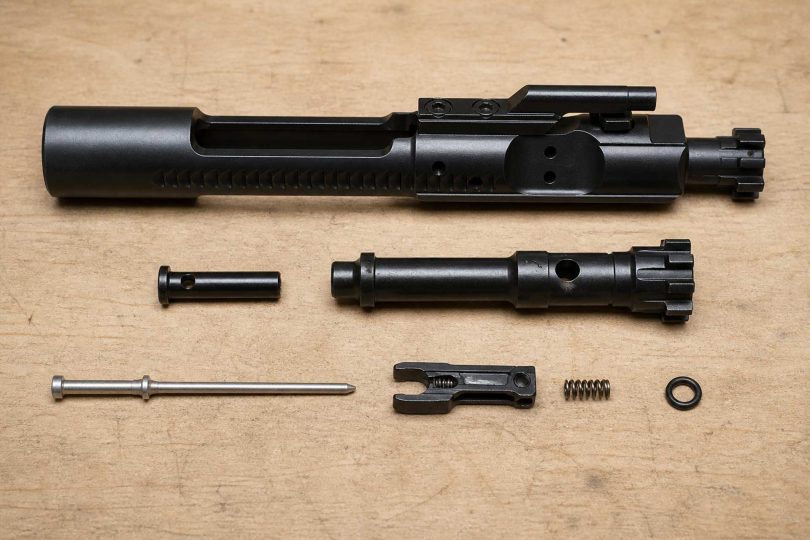

Bolt carrier group maintenance is one of the most practical skills you can develop as an AR-15 owner. It sits at the center of reliability, directly affecting how consistently your rifle cycles, how long components last, and how well the system performs under real-world use.
The bolt carrier group (BCG) handles feeding, firing, extracting, and ejecting—essentially the entire mechanical cycle of the rifle. That means every shot depends on its condition. If maintenance is neglected, issues don’t appear gradually—they show up as failures to feed, short stroking, or inconsistent extraction.
Understanding how to maintain the BCG also helps clarify how the system functions overall. When you look at the AR-15 cycle of operations, the bolt carrier group is the component that physically drives each stage forward. Keeping it clean and properly lubricated isn’t optional—it’s foundational.
This guide is for anyone who wants a clear, usable framework for maintaining their rifle without guesswork. It’s especially useful if you shoot regularly and want consistent reliability, are building or tuning a rifle, or need to diagnose recurring cycling issues.
It is not for readers looking for cosmetic cleaning or surface-level care. This is about function, wear management, and maintaining system performance.
What Bolt Carrier Group Maintenance Actually Means
Bolt carrier group maintenance is not just cleaning—it’s a combination of inspection, lubrication, and wear management. Each of these plays a different role in keeping the system functioning.
At a basic level, the BCG works by cycling back and forth under gas pressure. If you understand how the bolt carrier group works, maintenance becomes easier because you know where stress and fouling actually occur.
There are three core elements:
Cleaning removes carbon buildup, debris, and fouling that can interfere with movement or sealing.
Lubrication reduces friction between moving surfaces and helps maintain consistent cycling under heat.
Inspection identifies wear before it turns into failure—things like gas ring wear, extractor tension, or carrier key issues.
Why this matters: the AR-15 system—especially in direct impingement vs piston systems—routes gas into the carrier itself. That design is efficient, but it also means the BCG sees more heat and fouling than many other systems.
Maintenance isn’t about keeping the rifle spotless. It’s about maintaining function where it matters.
A Practical Maintenance Framework
Instead of guessing when or how to clean your BCG, it helps to follow a structured approach.
After Each Range Session
This level is about consistency, not deep cleaning. Wipe down the carrier exterior, add lubrication to friction points, and check for obvious debris or fouling buildup. This keeps the system running between deeper maintenance intervals.
Periodic Deep Cleaning
After several hundred rounds—or when performance starts to change—you move to a more thorough cleaning. This includes removing carbon from the bolt tail, cleaning inside the carrier, inspecting gas rings, and checking extractor and ejector movement.
If you’re unsure where to start, a focused walkthrough like how to clean a bolt carrier group provides a step-by-step process.
Inspection-Based Maintenance
This is where most reliability gains come from. You’re looking for gas ring wear or gaps, extractor spring fatigue, carrier key looseness, and unusual wear patterns.
This ties directly into diagnosing problems. If issues appear, they often connect to patterns covered in a bolt carrier group troubleshooting guide.
Why this matters: maintenance isn’t time-based—it’s condition-based. The rifle tells you what it needs if you know where to look.
Where Maintenance Fits in the System
The bolt carrier group does not operate in isolation. It’s part of a larger system that includes gas pressure, buffer weight, and receiver alignment.
If you zoom out to AR platform fundamentals, you’ll see that the BCG interacts with multiple subsystems. The gas system delivers energy, the buffer system controls rearward motion, and the receivers guide alignment and containment.
For example, understanding AR-15 buffer system basics helps explain why a properly lubricated BCG still won’t cycle correctly if buffer weight is mismatched.
Similarly, the gas system plays a direct role. When you understand how the AR-15 gas system works, you can see why carbon buildup occurs where it does—and why lubrication matters.
This system-level view prevents misdiagnosis. Many “BCG problems” are actually system balance issues.
Common Maintenance Mistakes and Why They Matter
Maintenance errors often come from overcorrecting or misunderstanding priorities.
Over-Cleaning
Scraping every bit of carbon from the bolt tail is unnecessary. Carbon buildup in that area rarely affects function unless extreme.
Why this matters: excessive scraping can cause wear faster than fouling.
Under-Lubrication
Running the BCG dry is one of the most common causes of reliability issues.
Why this matters: friction increases, cycling slows, and heat builds up quickly.
Ignoring Wear Points
Gas rings, extractor springs, and carrier keys are small components that fail quietly.
Why this matters: these failures show up as inconsistent cycling rather than obvious breakage.
Many of these mistakes overlap with patterns seen in common AR build mistakes, especially when builders focus on parts selection but ignore maintenance realities.
When Maintenance Becomes a Performance Decision
Maintenance is not just about preventing failure—it can influence performance.
A well-maintained BCG cycles more consistently, handles heat more effectively, and reduces wear on adjacent components. At a certain point, maintenance intersects with equipment quality. Lower-quality carriers or improperly staked keys may require more attention or fail earlier.
This is where evaluating best bolt carrier groups becomes relevant. Better materials, coatings, and assembly standards reduce maintenance burden.
If reliability is the priority, focusing on options like best bcg for reliability aligns maintenance with performance expectations.
Why this matters: maintenance cannot compensate for poor component quality—but it can maximize the performance of a good one.
Frequently Asked Questions About Bolt Carrier Group Maintenance
How often should you clean a bolt carrier group?
There is no fixed round count that applies to every rifle. Light cleaning after each range session helps maintain consistency, while deeper cleaning should be based on fouling buildup and performance changes. If the rifle begins to feel sluggish or inconsistent, that’s usually a signal to clean.
What parts of the bolt carrier group wear out first?
Gas rings, extractor springs, and small internal components tend to wear first. These parts are inexpensive but critical to function, so inspecting them regularly prevents larger reliability issues.
Can you run a bolt carrier group without lubrication?
You can, but you shouldn’t. A dry BCG increases friction, heat, and wear. Even minimal lubrication dramatically improves cycling consistency and reduces stress on the system.
Does carbon buildup cause malfunctions?
Carbon buildup alone rarely causes immediate failure. Most malfunctions happen when fouling combines with lack of lubrication or worn components. Cleaning helps, but lubrication is often more important for maintaining function.
Is piston system maintenance different from direct impingement?
Yes. In piston systems, fouling is concentrated near the piston assembly rather than inside the carrier. However, the BCG still requires lubrication and inspection, just with less internal carbon buildup.
What happens if you ignore bolt carrier group maintenance?
Ignoring maintenance leads to increased friction, inconsistent cycling, and eventually malfunctions. Over time, it can also accelerate wear on multiple components, not just the BCG itself.
Conclusion
Bolt carrier group maintenance is not complicated—but it is essential. It sits at the intersection of function, reliability, and system performance.
When you understand how the BCG fits into the AR-15 parts overview and how it drives the rifle cycling process, maintenance becomes a logical process rather than a checklist.
The goal is not perfection. It’s consistency.
Clean when needed. Lubricate properly. Inspect critical components. And most importantly—understand how the system works so your decisions are based on function, not habit.
That’s what keeps the rifle running.



Leave a Comment