



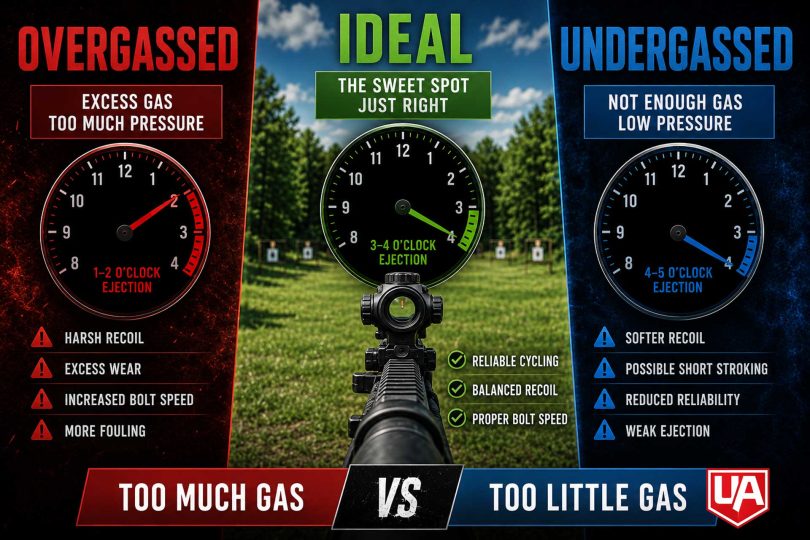

An AR-15 does not need excessive recoil or violent cycling to function reliably. In fact, the most dependable rifles usually operate within a fairly balanced gas window where bolt speed, extraction timing, and buffer resistance all work together predictably. When that balance shifts too far in either direction, the rifle begins showing symptoms that shooters often misdiagnose.
An overgassed rifle typically cycles too aggressively. An undergassed rifle cycles too weakly. Both conditions can create reliability problems, inconsistent ejection, accelerated wear, and erratic shooting behavior. The challenge is that many symptoms overlap, especially once aftermarket parts, suppressors, ammunition differences, and buffer changes enter the equation.
Understanding the difference between overgassed and undergassed behavior requires a broader understanding of how the AR-15 gas system works. Gas pressure alone is only part of the equation. Bolt carrier velocity, dwell time, extraction timing, buffer weight, spring tension, and ammunition pressure all influence how the rifle cycles.
This matters because many shooters attempt to solve reliability issues by replacing random components instead of diagnosing the actual cause. A heavier buffer may improve one rifle while making another less reliable. Adjustable gas systems can smooth recoil, but they can also create short-stroking problems if tuned incorrectly. Even something as simple as weak ammunition can imitate symptoms that look mechanical.
This guide explains the difference between overgassed and undergassed AR-15 systems, how to recognize the symptoms of each condition, what causes them, and which corrective changes actually make sense. The goal is not simply to reduce recoil or tune for softness. The goal is to maintain reliable, repeatable cycling across the rifle’s intended use case.
What Overgassed and Undergassed Mean
An AR-15 gas system controls how much pressure is redirected from the barrel back into the operating system. That pressure drives the bolt carrier rearward, unlocks the bolt, extracts the spent casing, compresses the buffer system, and chambers the next round as the carrier returns forward.
The entire sequence is part of the AR-15 cycle of operations. Gas pressure is what initiates that cycle, but the rifle only functions correctly when all moving components stay within a balanced operating range.
An overgassed AR-15 receives more gas pressure than necessary for stable cycling. This usually results in excessive bolt speed, sharper recoil impulse, more violent extraction, and accelerated wear on internal components. The rifle still functions, but it operates harder than it needs to.
An undergassed AR-15 does not receive enough gas pressure to complete the cycle consistently. The bolt carrier may move partially rearward but fail to travel far enough to eject the spent casing, strip the next round, or lock back on an empty magazine.
Both conditions affect the rifle cycling process in different ways. Overgassing tends to increase mechanical stress while undergassing reduces reliability through incomplete movement.
This distinction matters because many shooters assume reliability issues always come from insufficient gas. In reality, excessive gas can create problems that initially appear similar, especially once extraction timing becomes unstable.
Gas balance also changes depending on barrel length, suppressor use, ammunition pressure, gas system length, and buffer configuration. A rifle that cycles correctly unsuppressed may become heavily overgassed with a suppressor attached. A rifle tuned for soft recoil with match ammunition may become unreliable when firing weaker training loads.
The AR platform is modular enough that many cycling issues can be corrected without replacing the rifle itself. But diagnosing those issues correctly starts with understanding what the symptoms actually indicate.
Symptoms of an Overgassed AR-15
An overgassed rifle usually cycles aggressively enough that the shooter notices the behavior immediately. Recoil often feels sharper than expected, brass ejects forcefully, and internal wear increases over time.
One of the most common indicators is forward ejection. Brass consistently ejecting toward the 1 o’clock or 2 o’clock position often suggests excessive bolt velocity. The carrier begins extracting and ejecting the case too aggressively because gas pressure is driving the system harder than necessary.
Another common symptom is unusually violent recoil impulse. The recoil itself may not feel heavier in raw force, but it often feels abrupt or “slappy” because the bolt carrier impacts the rear of the receiver extension more aggressively. Understanding AR-15 buffer system basics helps explain why excessive carrier speed changes recoil feel so dramatically.
Overgassed rifles also tend to run dirtier when suppressed. Increased back pressure forces additional gas into the receiver, often causing excess fouling around the bolt carrier group and charging handle area. This is one reason many suppressed shooters eventually study direct impingement vs piston systems when comparing operating behavior.
Mechanical wear can also increase noticeably. Extractors, ejectors, gas rings, and buffer components experience more stress when the carrier cycles excessively fast. Over time, this can shorten component lifespan and increase parts breakage.
Some rifles also begin showing extraction-related malfunctions because the bolt unlocks too early while chamber pressure remains relatively high. This can create torn case rims, inconsistent ejection, or erratic reliability that resembles extractor failure.
Shooters sometimes attempt to solve these issues with random component changes, but diagnosing root cause matters more than chasing symptoms. A rifle may appear overgassed because of improper dwell time, weak buffer resistance, suppressor pressure, or even poorly tuned ammunition selection. Understanding AR-15 dwell time explained becomes especially important when diagnosing shorter-barreled rifles.
Overgassing is often survivable in the short term because the rifle still cycles forcefully. The downside is that the operating system absorbs unnecessary stress over thousands of rounds.
Symptoms of an Undergassed AR-15
An undergassed AR-15 usually reveals itself through incomplete cycling rather than excessive force. Instead of violent movement, the rifle lacks enough operating energy to complete the cycle consistently.
Short stroking is one of the clearest indicators. The bolt carrier begins moving rearward but does not travel far enough to eject the spent casing or chamber the next round. Sometimes the rifle partially extracts the case before trapping it inside the receiver during the return cycle.
Failure to lock back on an empty magazine is another common symptom. If the bolt consistently fails to engage the bolt catch after the last round, the system may not be generating enough rearward travel to complete full cycling.
Weak or inconsistent ejection patterns also matter. Brass ejecting softly near the shooter, dribbling weakly from the ejection port, or falling unpredictably can indicate insufficient gas pressure or inadequate carrier velocity.
Undergassed systems often feel deceptively smooth. Some shooters initially mistake this for a well-tuned rifle because recoil feels softer. But soft recoil combined with inconsistent cycling usually points toward insufficient operating energy rather than efficient tuning.
Several mechanical causes can contribute to undergassing:
- undersized gas ports
- gas block misalignment
- leaking gas keys
- excessive buffer weight
- weak ammunition
- excessive fouling
- excessive spring resistance
Diagnosing the problem correctly requires understanding how the bolt carrier group works because carrier movement is directly tied to how efficiently the gas system transfers energy through the operating cycle.
Gas leakage is especially common on improperly assembled rifles. Loose carrier keys, worn gas rings, or alignment issues reduce operating efficiency enough to create reliability problems. This is why inspecting gas key staking explained becomes important during troubleshooting.
Unlike overgassed systems, undergassed rifles usually stop functioning before excessive wear becomes the primary concern. Reliability degrades first because the system lacks enough energy to maintain consistent operation.
What Causes Gas Imbalance in an AR-15
Most cycling problems come from interaction between components rather than a single defective part. The AR platform is highly modular, which means changes to one system often influence multiple operating characteristics simultaneously.
Barrel length and gas system length heavily influence pressure timing. Shorter barrels typically create sharper pressure curves, especially when paired with carbine-length gas systems. Longer gas systems generally smooth out impulse and reduce bolt velocity.
Suppressors dramatically alter operating behavior by increasing back pressure. Many rifles that cycle normally without a suppressor become overgassed once suppression is added. This is especially noticeable in shorter-barreled rifles where pressure timing is already aggressive.
Buffer weight also changes system balance. Heavier buffers slow carrier velocity and delay rearward movement slightly. Lighter buffers allow the system to cycle faster. Understanding buffer tube types and differences helps clarify why recoil characteristics vary so much between rifle configurations.
Ammunition pressure matters more than many shooters realize. Weak range ammunition can create symptoms that resemble undergassing even when the rifle itself is mechanically correct. Conversely, hotter defensive or military loads can increase bolt velocity enough to exaggerate overgassing symptoms.
Parts compatibility also matters. Mixing aftermarket carriers, springs, adjustable gas systems, and proprietary buffers without understanding system balance often creates avoidable reliability issues. This is why AR-15 parts compatibility basics become increasingly important as rifles move away from standard configurations.
Some issues originate from assembly mistakes rather than tuning. Misaligned gas blocks, improperly torqued carrier keys, incorrect buffer systems, and incompatible springs all contribute to cycling instability. Many of these issues appear repeatedly in common AR build mistakes because builders often diagnose symptoms instead of system relationships.
The important point is that gas imbalance is rarely isolated to a single component. Reliable tuning requires understanding how the operating system behaves as a whole.
How to Correct an Overgassed AR-15
Correcting an overgassed rifle usually involves slowing carrier velocity and reducing unnecessary operating force without compromising reliability.
The simplest correction is often buffer adjustment. Increasing buffer weight adds resistance to the system and slows rearward carrier movement slightly. Many rifles benefit from moving from a standard carbine buffer to H1, H2, or H3 configurations depending on barrel length and suppressor use.
Spring tuning can also help stabilize movement. Stronger action springs increase forward return pressure and slightly reduce carrier speed during cycling.
Adjustable gas blocks provide more direct tuning control by restricting how much gas enters the system in the first place. This approach is especially useful on suppressed rifles where back pressure becomes excessive.
However, tuning too aggressively creates risk. A rifle optimized for soft recoil with full-power ammunition may become unreliable when using weaker loads or shooting in colder conditions. Reliability margin matters more than chasing the softest possible recoil impulse.
Carrier selection can also influence operating characteristics. Some enhanced carriers are designed to manage gas more efficiently or delay unlocking slightly under pressure. This is one reason shooters researching reliability upgrades often compare options inside a bolt carrier group buying guide before replacing components.
Maintenance matters as well. Carbon buildup, worn springs, and inconsistent lubrication all affect cycling characteristics over time. Regular inspection and bolt carrier group maintenance help preserve predictable operation.
Suppressor users frequently benefit from reliability-focused components designed for increased pressure environments. Many shooters evaluating suppressed setups eventually compare the best BCG for reliability when tuning rifles intended for higher round counts.
The goal is not to eliminate movement. The goal is to create controlled, repeatable cycling that maintains reliability while reducing unnecessary operating stress.
How to Correct an Undergassed AR-15
Correcting an undergassed rifle begins with identifying whether the problem comes from restricted gas flow, excessive resistance, or weak ammunition.
Gas block alignment is one of the first areas to inspect. Even slight misalignment between the gas port and block can reduce operating pressure enough to create short-stroking behavior.
Carrier key leakage should also be checked carefully. Poor staking or loose fasteners allow pressure to escape before the carrier receives enough force to cycle correctly. Inspecting bolt carrier group troubleshooting guide procedures can help isolate these issues systematically.
Buffer systems also matter. Excessively heavy buffers or overly stiff springs can prevent the carrier from reaching full travel. Builders sometimes overcompensate while attempting to reduce recoil and unintentionally create undergassing symptoms.
Ammunition testing is important before replacing parts. Some rifles cycle perfectly with NATO-pressure loads but struggle with weaker commercial ammunition. Diagnosing the rifle with multiple ammunition types prevents unnecessary modifications.
Fouling can also reduce reliability significantly. Carbon buildup around the gas block, carrier, or chamber area increases resistance and decreases operating efficiency over time. Regular how to clean a bolt carrier group procedures often restore reliability in rifles that initially appear mechanically defective.
Some rifles simply require better-matched components. Improper carrier dimensions, worn gas rings, or inconsistent machining tolerances can reduce efficiency enough to create marginal cycling behavior. Shooters building reliability-focused systems often compare the best bolt carrier groups when trying to eliminate tolerance-related inconsistencies.
If reliability problems continue after basic inspection, the issue may involve broader operating relationships such as timing, pressure duration, or unlocking behavior. Studying the bolt locking and unlocking process helps clarify how extraction timing influences overall cycling stability.
Reliable tuning is rarely about maximizing one variable. It is about balancing gas pressure, operating mass, and spring resistance together.
FAQ About Overgassed vs Undergassed AR-15 Systems
Is forward ejection always a sign of an overgassed AR-15?
Not always. Forward ejection often suggests excessive bolt velocity, but ejection pattern alone is not definitive. Extractor tension, ejector condition, ammunition pressure, and buffer configuration all influence brass direction. Consistent forward ejection combined with sharp recoil and aggressive cycling is a stronger indicator of overgassing.
Can a suppressor make an AR-15 overgassed?
Yes. Suppressors increase back pressure, which redirects more gas into the operating system. Rifles that cycle normally unsuppressed often become noticeably overgassed once a suppressor is attached. This is especially common with shorter barrels and carbine-length gas systems.
What causes short stroking in an AR-15?
Short stroking usually results from insufficient operating energy. Common causes include gas leakage, gas block misalignment, weak ammunition, excessive buffer weight, fouling, or worn internal components. Diagnosing the root cause requires evaluating the system as a whole instead of replacing random parts.
Does a heavier buffer fix overgassing?
Sometimes, but not always. Heavier buffers reduce bolt velocity and soften recoil impulse by increasing system resistance. However, adding too much buffer weight can create undergassing symptoms if the rifle no longer cycles reliably with all ammunition types.
Why does my AR-15 feel harsh even though it functions correctly?
Reliable function does not always mean optimal balance. Some rifles cycle far more aggressively than necessary, especially factory carbines designed to prioritize reliability across wide ammunition ranges. Excessive carrier speed can create sharper recoil impulse even when the rifle remains mechanically reliable.
Can poor maintenance imitate gas system problems?
Absolutely. Carbon buildup, worn springs, leaking gas keys, and dry carrier assemblies all affect cycling behavior. Many rifles that appear undergassed actually suffer from maintenance-related efficiency loss rather than incorrect gas pressure.
Conclusion
The difference between an overgassed and undergassed AR-15 is ultimately a question of operating balance. One system cycles too aggressively while the other lacks enough energy to complete the cycle consistently. Both conditions reduce efficiency, increase wear or malfunctions, and complicate reliability.
Diagnosing these problems correctly requires more than observing recoil or ejection patterns in isolation. Bolt velocity, dwell time, buffer resistance, ammunition pressure, suppressor use, and carrier efficiency all interact together inside the operating cycle. A rifle rarely becomes unstable because of one single variable alone.
This is why understanding broader AR platform fundamentals matters before making major tuning decisions. Reliable rifles are not necessarily the softest-shooting rifles or the most heavily modified rifles. They are systems balanced for their intended use case.
For some shooters, that may mean tuning a suppressed rifle for smoother recoil. For others, it may mean preserving maximum reliability with duty ammunition across harsh conditions. The correct setup depends on how the rifle is actually used.
The important distinction is that diagnosing symptoms should come before replacing components. Once the underlying cause is understood, tuning decisions become far more predictable—and far less expensive.



Leave a Comment