



Understanding mil-spec vs commercial buffer tube dimensions is one of those details that seems minor—until it causes a compatibility problem that stops a build in its tracks. The buffer tube, also called the receiver extension, directly determines what stocks will fit, how securely they mount, and whether your rifle components align correctly.
At a glance, mil-spec and commercial buffer tubes appear nearly identical. They thread into the same lower receiver and serve the same purpose in the buffer system. But the differences in diameter, shape, and manufacturing approach create real consequences for fitment. That’s why builders who skip this distinction often end up with loose stocks, improper alignment, or parts that simply won’t install.
To understand where these differences matter, it helps to see how the buffer system fits into the broader AR platform fundamentals. The buffer tube is not just a mounting point—it’s a structural component that interacts with the recoil system and stock interface.
This guide breaks down those dimensional differences clearly, explains how they affect compatibility, and shows how to make the right choice based on your build goals. If you’re selecting parts, troubleshooting fitment, or evaluating components, this is where precision starts to matter.
What Buffer Tube Dimensions Actually Mean
When comparing mil-spec and commercial buffer tubes, you’re not just looking at size—you’re looking at how dimensional tolerances affect the entire rear interface of the rifle.
The buffer tube sits at the rear of the lower receiver and houses the buffer and spring, supporting the rifle’s recoil cycle. That role becomes clearer when you understand how the AR-15 gas system works, because the buffer system works in direct coordination with gas pressure and bolt movement.
But dimensionally, two factors matter most:
- Outer diameter
- Rear profile shape
These two variables determine whether a stock will fit properly and whether it will lock securely in place.
A buffer tube also connects directly to the lower receiver, which makes it part of the overall structural system explained in AR-15 parts overview. That context matters because compatibility isn’t isolated—it’s part of a larger system of tolerances.
Why this matters:
Even a small difference in diameter can prevent a stock from sliding on or cause it to wobble under use. The buffer tube is one of the few components where “close enough” does not work.
Mil-Spec vs Commercial Dimensions (The Actual Differences)
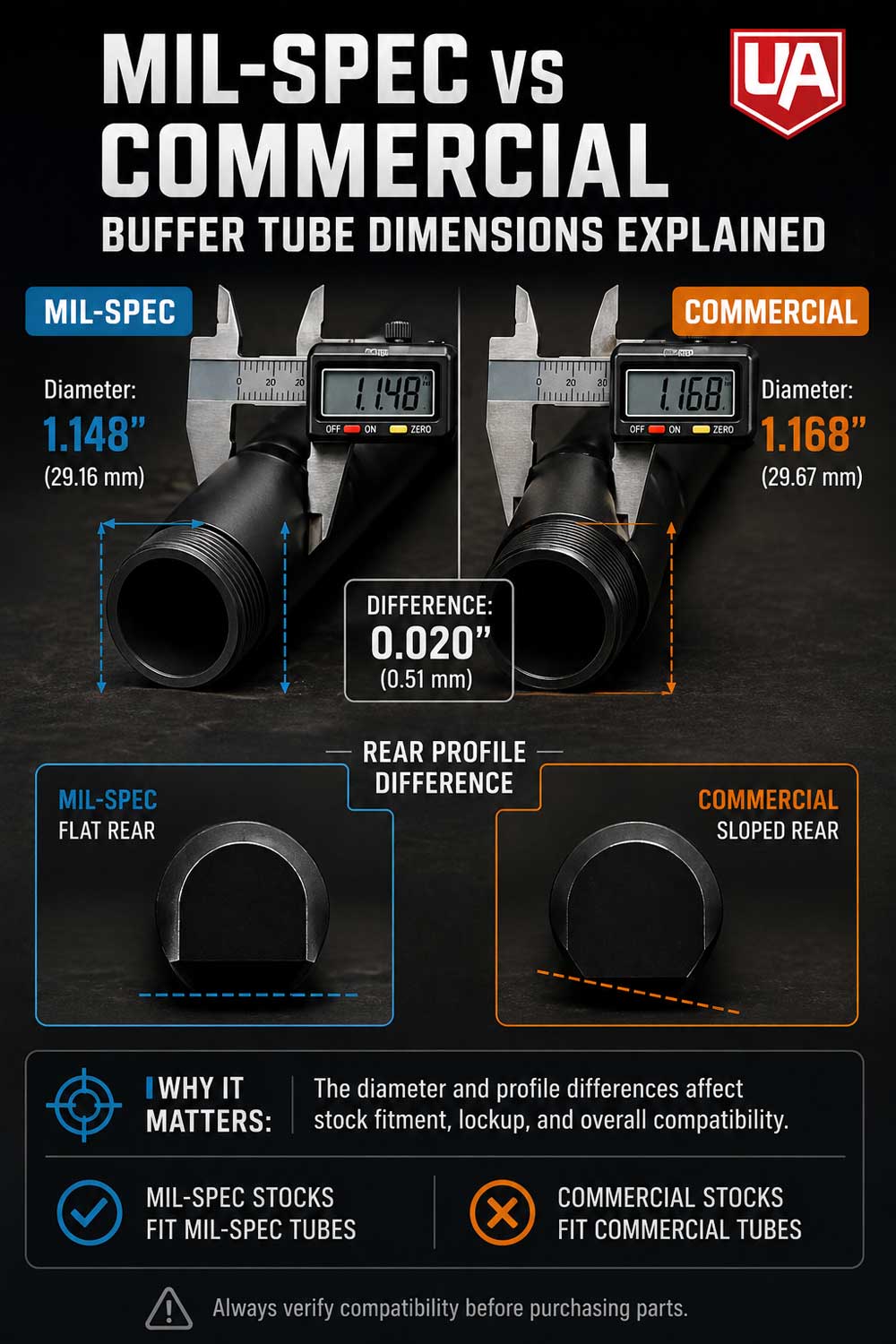
At a technical level, the difference between mil-spec and commercial buffer tubes comes down to precise measurements and geometry.
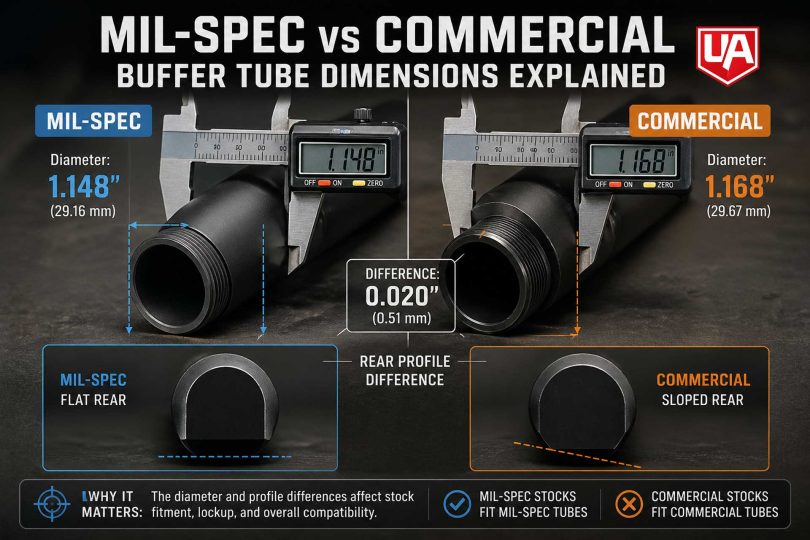
Mil-Spec Buffer Tube Dimensions
- Outer diameter: ~1.148 inches
- Material: typically forged from 7075-T6 aluminum
- Rear profile: flat
- Thread rolling process: stronger, more consistent
Commercial Buffer Tube Dimensions
- Outer diameter: ~1.168 inches
- Material: often extruded 6061 aluminum
- Rear profile: slanted
- Threading: cut rather than rolled
That difference of about 0.02 inches may seem minor, but it directly affects stock compatibility. Stocks designed for mil-spec tubes will not fit on commercial tubes, and vice versa.
These dimensional differences are part of the broader comparison found in mil-spec vs commercial AR parts, where manufacturing standards and tolerances define compatibility across the platform.
Why this matters:
The diameter difference determines the internal channel size of the stock. A mismatch means either:
- The stock won’t install
- The stock installs but remains loose and unstable
How Dimensions Affect Stock Fitment
The most immediate impact of buffer tube dimensions shows up in stock compatibility.
Stocks are built to match either mil-spec or commercial diameters. Because of that, choosing the wrong tube means you’re also locking yourself into—or out of—specific stock options.
To understand the mechanical side of this, it helps to look at how AR-15 stocks attach. Stocks slide over the buffer tube and lock into adjustment notches. If the diameter or profile is off, the locking mechanism doesn’t engage correctly.
This also ties into the function of the lower receiver itself, which you can see in AR-15 lower receiver function. The buffer tube threads into the receiver, making it a structural anchor point for the stock.
Practical outcomes of mismatch:
- Loose stock with excessive movement
- Inability to mount the stock
- Misalignment affecting shooting stability
Why this matters:
Stock fitment isn’t just about comfort—it affects control, repeatability, and overall handling.
Compatibility Framework: What Works and What Doesn’t
When evaluating buffer tube compatibility, you’re not just comparing two parts—you’re navigating a system of interdependent components.
A simplified framework:
| Buffer Tube Type | Compatible Stock Type | Result |
|---|---|---|
| Mil-Spec | Mil-Spec Stock | Proper fit |
| Mil-Spec | Commercial Stock | Too loose |
| Commercial | Commercial Stock | Proper fit |
| Commercial | Mil-Spec Stock | Won’t fit |
This is why builders often refer to a buffer tube types and differences before selecting parts—it sets expectations before compatibility becomes a problem.
For a more complete compatibility breakdown, the the buffer tube compatibility chart provides a visual reference that helps avoid common mistakes.
Why this matters:
Compatibility errors don’t just cost time—they often require replacing parts that are otherwise perfectly functional.
Use Cases: When Each Type Makes Sense
Choosing between mil-spec and commercial buffer tubes isn’t just about dimensions—it’s about context.
When Mil-Spec Makes Sense
- You want maximum stock compatibility
- You’re building with widely available components
- You prefer stronger materials and tighter tolerances
Mil-spec tubes align better with the modular approach described in modular rifle design, where interchangeability is a priority.
When Commercial Makes Sense
- You’re using an existing commercial stock
- You’re upgrading a legacy rifle
- Availability dictates your choice
That said, commercial tubes are less common in modern builds.
Why this matters:
Choosing the right standard early prevents limitations later in the build process.
Common Mistakes and How to Avoid Them
One of the most frequent issues in AR builds is overlooking buffer tube specifications entirely.
These mistakes often appear in builds highlighted in common AR build mistakes, where mismatched components create avoidable problems.
Common Errors:
- Assuming all buffer tubes are the same
- Buying a stock without checking tube type
- Mixing mil-spec and commercial components
- Ignoring rear profile differences
How to Avoid Them:
- Confirm tube diameter before purchasing a stock
- Stick to mil-spec unless you have a reason not to
- Use compatibility references early in the build
Why this matters:
Most compatibility problems aren’t complex—they’re preventable with basic awareness.
Where This Fits in the Build Process
Buffer tube selection typically happens during lower receiver assembly, but its impact extends across the entire rifle.
The lower receiver is the serialized core of the firearm, as explained in which firearm parts are serialized. That makes every attached component—including the buffer tube—part of a permanent structural system.
It also ties into broader system behavior, including how AR rifles cycle, because the buffer and spring housed in the tube directly influence recoil management.
Why this matters:
The buffer tube is both a compatibility component and a functional part of the rifle’s operating system.
Buying Considerations and Upgrade Path
If you’re evaluating parts, buffer tube selection naturally leads into purchasing decisions.
Most builders default to mil-spec, which is why many recommendations focus on best AR-15 buffer tubes. These options prioritize compatibility and material strength.
If you’re building from scratch, pairing your buffer tube with complete AR build kits can simplify the process by ensuring component alignment from the start.
Why this matters:
The right buffer tube eliminates friction in both assembly and future upgrades.
FAQ: Mil-Spec vs Commercial Buffer Tube Dimensions
What is the exact diameter difference between mil-spec and commercial buffer tubes?
Mil-spec buffer tubes are approximately 1.148 inches in diameter, while commercial tubes measure around 1.168 inches. That small difference is enough to prevent cross-compatibility between stocks.
Can you put a mil-spec stock on a commercial buffer tube?
No. A mil-spec stock is designed for a smaller diameter and will not fit onto a commercial buffer tube.
Can a commercial stock fit on a mil-spec buffer tube?
A commercial stock may slide onto a mil-spec tube, but it will be loose and unstable, making it unsuitable for practical use.
How can you tell if a buffer tube is mil-spec or commercial?
You can measure the outer diameter or check the rear profile. Mil-spec tubes have a flat rear, while commercial tubes typically have a slanted back.
Does buffer tube size affect rifle performance?
The size itself doesn’t directly affect performance, but improper fitment can impact stability, handling, and overall shooting consistency.
Why is mil-spec more common than commercial?
Mil-spec buffer tubes are more widely adopted due to standardized dimensions, better material strength, and broader compatibility with aftermarket parts.
Conclusion
Mil-spec vs commercial buffer tube dimensions are a small but critical detail in AR builds. The difference in diameter and profile determines whether your stock fits correctly, whether your components align properly, and whether your rifle performs as expected.
For most builds, mil-spec offers better compatibility, stronger materials, and fewer limitations. Commercial tubes still have their place, but they require more careful matching of components.
The key takeaway is simple:
dimension drives compatibility.
Understanding that principle—and applying it early—prevents problems later.